© 2024 by Korean Asphalt Institute
ABSTRACT
1. 서 론
2. 항만부두 분류를 위한 문헌분석 및 분류인자 개선방안 제안
2.1 국내외 항만분류방법 문헌 및 기존 보고서 분석
2.2 공공데이터포털을 활용한 항만정보수집
2.3 기존 방식과 새로운 방식 비교
3. 여러 가지 항만부두 분류법을 통한 결과 비교분석
4. 결 론
1. 서 론
기존 항만을 건설 시 설계조건에는 화물차전용 아스팔트포장 주차장을 고려하지 않고 있었다. 또한 해양수산부에서 고시한 ‘제2차 신항만건설기본계획(2019~2040)’에 따르면 새롭게 건설될 신설항만이 총 11개의 항이 있는 것을 생각할 때 앞으로 추가로 건설될 항만을 위해 화물차전용 아스팔트포장 주차장 설계에 대하여 연구가 필요한 실정이다. 현재 항만에선 항만을 출입하는 화물차의 전용주차장 주차공간 부족사태가 발생하여 화물차가 주차장 이외에 도로 위 불법주차를 할 수밖에 없게 되고 그로 인해 가시거리 미확보, 급차선변경으로 교통사고 위험이 상존한다. 또한 물동량이 증가함에 따라 화물차 통행량 또한 급증되면서 주차공간 부족 현상이 발생하게 된 것이다. 따라서 화물차전용 아스팔트포장 주차장 공급필요성에 의해 기존 연구(Choi et al., 2022, 2023)의 항만분류(Fig. 1, Tables 1~2)의 경우 14개의 국가무역항 항만 전체에 초점을 두어 분류방법이 제안되었다. 이때 기존 연구의 항만 전체를 대상으로 한 항만분류 방법은 신설 항만의 부두를 단계별로 설계 시 유사시설 항만 조사를 실시 후 아스팔트포장 주차장을 설계할 때 과소하거나 과대하게 설계될 수 있다는 문제점이 있다. 따라서 본 연구에서는 화물차전용 아스팔트포장 주차장 설계를 위하여 유사시설 조사 시 알맞은 방법을 통하여 조사를 실시할 수 있도록 그릅핑한 항만 부두에 관하여 분류체계를 수립하여 새로운 국내 항만분류 방법을 제안하고자 한다.
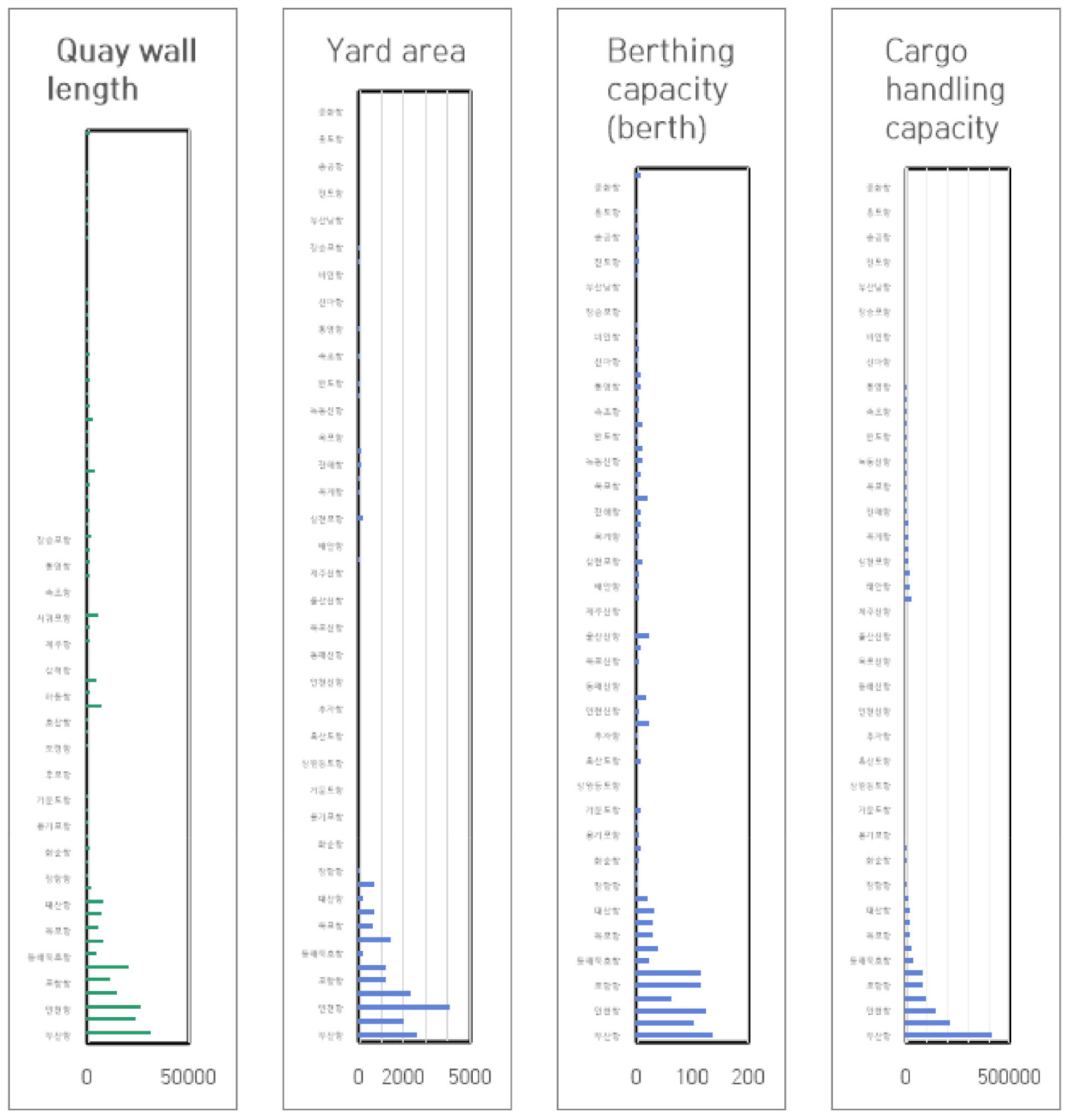
Fig. 1.
Port classification according to the four conditions of the previous study (Choi et al., 2022)
Table 1.
Classification criteria
based on port information
|
Compliance with
conditions
|
Port Name
|
CASE 1
(quay length: more than or equal to
20000, yard: more than or equal to
2000, berthing capacity: more than
or equal to 100, caego handling
capacity : more than or equal to
100000)
|
Meet all four
conditions
|
Incheon Port, Gwangyang Port, Busan Port
|
Meet only three
conditions
|
Incheon Port, Gwangyang Port, Busan Port, Pyeontaek-Dangjin
Port
|
Meet only two
conditions
|
Incheon Port, Gwangyang Port, Busan Port, Pyeontaek-Dangjin
Port, UlSan Port
|
Meet only one
condition
|
Incheon Port, Gwangyang Port, Busan Port, Pyeontaek-Dangjin
Port, UlSan Port, Pohang port
|
All conditions are
unmet
|
Dae-San Port, Masan Port, Gyeongin Port, Janghang Port, Mokpo
Port, Donghae Port, Mukho Port, other local-managed ports
|
CASE 2
(quay length: more than or equal to
10000, yard: more than or equal to
1000, berthing capacity: more than
or equal to 50, caego handling
capacity : more than or equal to
50000)
|
Meet all four
conditions
|
Incheon Port, Gwangyang Port, Busan Port, Pyeontaek-Dangjin
Port, UlSan Port, Pohang port
|
Meet only three
conditions
|
Incheon Port, Gwangyang Port, Busan Port, Pyeontaek-Dangjin
Port, UlSan Port, Pohang port
|
Meet only two
conditions
|
Incheon Port, Gwangyang Port, Busan Port, Pyeontaek-Dangjin
Port, UlSan Port, Pohang port
|
Meet only one
condition
|
Incheon Port, Gwangyang Port, Busan Port, Pyeontaek-Dangjin
Port, UlSan Port, Pohang Port, Gunsan Port
|
All conditions are
unmet
|
Dae-San Port, Masan Port, Gyeongin Port, Janghang Port, Mokpo
Port, Donghae Port, Mukho Port, other local-managed ports
|
Table 2.
Port classification considering port size and cargo handling capacity (Choi et al., 2022)
Port
classification criteria
|
Designated Port
|
Remarks section
|
|
G (Great)
|
Incheon Port, Gwangyang Port, Busan Port
|
Port that meets all four conditions in CASE 1
|
|
B (Big)
|
Pyeontaek-Dangjin Port, UlSan Port,
Pohang port, Gunsan Port
|
Port that meets at least one condition in CASE 2
|
|
N (Normal)
|
Other remaining ports
|
Port that dose not meet all four conditions in CASE 2
|
2. 항만부두 분류를 위한 문헌분석 및 분류인자 개선방안 제안
2.1 국내외 항만분류방법 문헌 및 기존 보고서 분석
본 연구에서는 항만분류 방법을 제안하기 위해 국내 항만의 현황을 조사하였다. 국내 항만 현황은 해양수산부에서 제시한 전국 항만위치도(Fig. 2)에 따르면 관리 주체에 따라 국가관리 및 지방관리로 구분하고 기능에 따라 무역항과 연안항으로 구분되고 있다. 이 내용을 통해 우리나라는 항만법, 시행령, 시행규칙 및 운영지침에 따라 Table 3과 같은 분류만이 존재한다는 사실을 확인하였다. 국외의 일본과 중국, 네덜란드의 경우 다른 항만분류 방법으로 항만분류체계를 보유 중이고 관리 주체 및 역할을 분명히 정의하고 있으며 기능별 분류(Tables 4,5,6)도 포함하고 있다.
국내에서도 항만의 외형적 특성 및 연간 물동량, 취급화물의 내용을 고려한 항만분류 연구가 수행된 바 있다. 먼저 Keum et al.(2000)은 항만의 외형적 조건으로 하역능력과 보관능력을 데이터로 사용하고, 실제 화물 취급에 관련된 데이터로 입출항 척수와 화물 처리량을 적용하였다. 그 후, 취급 화물 10종(컨테이너, 양곡, 유류, 비료, 시멘트, 유무연탄, 목재, 철광석, 기계류, 철재)에 대한 데이터를 FCM(Fuzzy C-Means) 알고리즘으로 분석하여 8개의 군집으로 하여 항만분류를 제안했다. 또한 한국해양수산개발원(2021)에서는 14개의 취급화물에 대하여 전국 무역항의 부두분류체계를 분석하여 컨테이너와 비컨테이너 두 가지로 구분하고 비컨테이너에서 3가지의 대분류, 6가지의 소분류로 구분하였다.
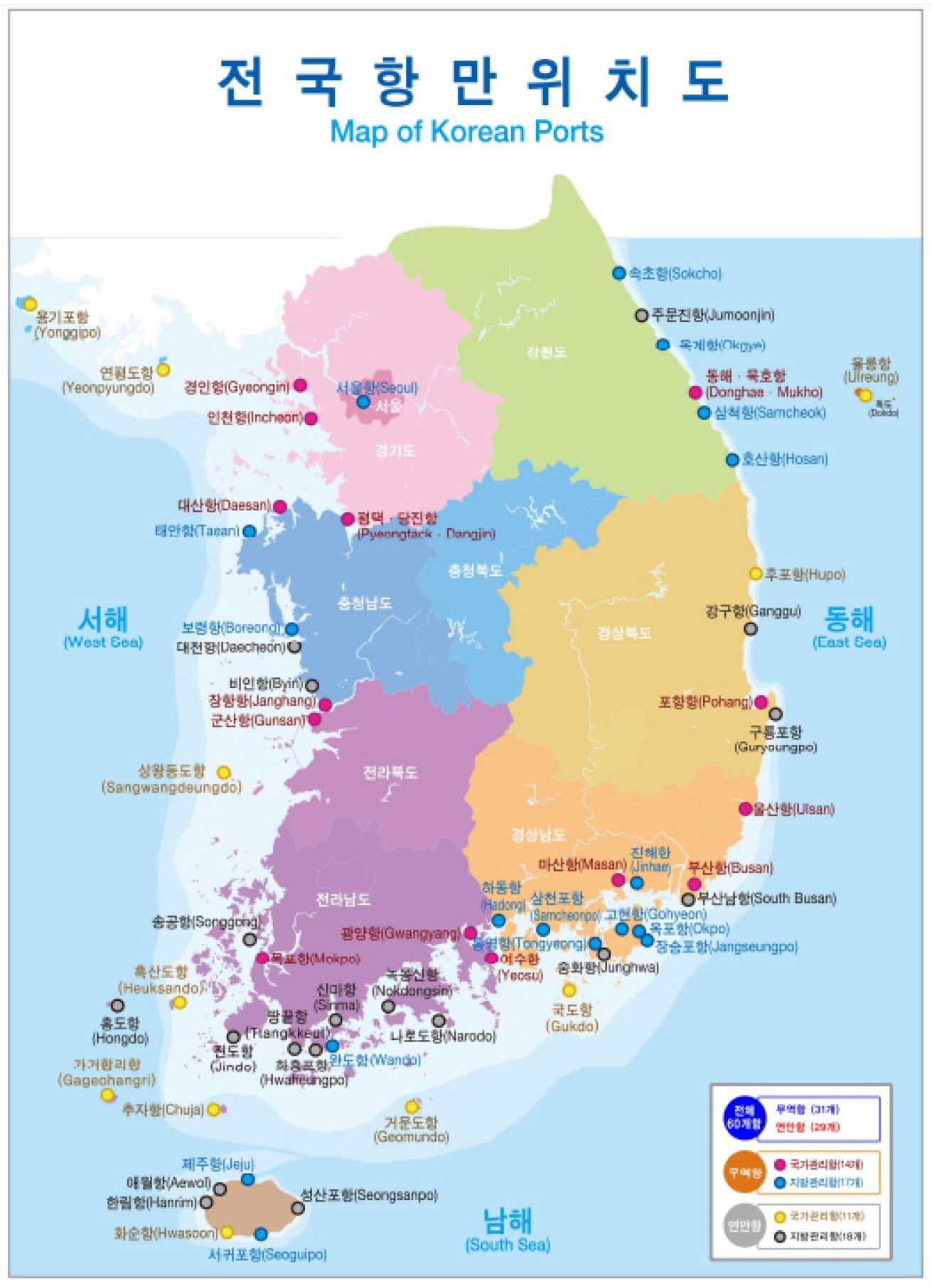
Fig. 2.
Table 3.
Functional
classification
|
management entity
|
Port Name
|
Trade ports
(31 locations)
|
National-
management
|
Incheon Port, Gyeongin Port, Pyeongtaek-Dangjin Port, Daesan Port, Gunsan
Port, Janghang Port, Mokpo Port, Gwangyang Port, Yeosu Port, Masan Port,
Busan Port, Ulsan Port, Pohang Port, Donghae-Mukho Port
|
Local-
management
|
Seoul Port,Boryeong Port, Taean Port, Wando Port, Samcheok Port,
Tongyeong Port , Gohyeon Port, Okpo Port, Jangseungpo Port, Jinhae Port,
Sokcho Port, Okgye Port, Samcheok Port, Hosan Port, Jeju Port, Seogwipo
Port, Hadong Port
|
Coastal ports
(29 locations)
|
National-
management
|
Yonggipo Port, Yeonpyeongdo Port, Sangwangdeungdo Port, Heuksando
Port, Gageo-ri Port, Geumundo Port, Gukdo Port, Hupo Port, Ulleung Port,
Chuja Port, Hwasun Port
|
Local-
management
|
Daecheon Port, Biin Port, Songgong Port, Hongdo Port, Jindo Port,
Ttangkkeut Port, Hwahongpo Port, Sinma Port, Nokdong New Port, Naro
Island Port, Jungwha Port, Busan South Port, Guryongpo Port, Ganggu Port,
Jumunjin Port, Aewol Port, Hanlim Port, Seongsanpo Port
|
Table 4.
Classification of Trade Ports in Japan Based on Handled Cargo (Korea Maritime Institute, 2021)
|
Type
|
Wharf name
|
Handling items and features
|
|
container
|
1
|
container
|
Equipped with large fixed gantry cranes, yard tractors, straddle carriers, and
other transfer equipment between the quay and the yard
|
non-
container
|
2
|
Coal, Iron ore
|
Coal, Iron ore
|
|
3
|
Steel (Iron products)
|
Steel products (coils, steel plates)
|
|
4
|
Scrap metal
|
Utilization of scrap metal for the import of raw materials for steel products and
the export of surplus scrap metal
|
|
5
|
Car
|
Due to the nature of cargo handling, there is a large-scale storage yard
|
|
6
|
Sand, Aggregate
|
Handling of sand and aggregate used in construction projects
|
|
7
|
Cement
|
Large-scale silos, conveyor belts, and storage warehouses are mostly installed.
|
|
8
|
Grains
|
Grain handling terminal (for soybeans, wheat, corn, etc.)
|
|
9
|
Agricultural products
|
Most are equipped with temperature-controlled warehouses to prevent oxidation
of agricultural products.
|
|
10
|
Seafood
|
Equipped with refrigerated and frozen storage facilities at the terminal
|
|
11
|
General cargo
|
A terminal capable of handling a variety of items such as steel, machinery, sand,
liquid cargo, and general cargo
|
|
12
|
Wood
|
Equipped with a floating timber storage facility on the water, in addition to
land-based storage facilities
|
|
13
|
Oil
|
Handling of crude oil and petroleum products
|
|
14
|
Gas
|
Terminal for handling liquefied gases such as LNG and LPG
|
Table 5.
China’s Trade Port Classification System (Choi, 2018)
|
Type
|
Wharf name
|
Handling items and features
|
|
Container
|
1
|
Container
|
container
|
Non-
container
|
2
|
Coal
|
Coal and coal processing agents
|
|
3
|
Ironstone
|
Cargo related to metal ores
|
|
4
|
Grain
|
Grain cargo
|
|
5
|
Car
|
Car
|
|
6
|
Crude oil
|
Crude oil
|
|
7
|
LNG
|
LNG
|
|
8
|
Other Wharf
|
Cement, Timber, Non-metallic ores, Chemical fertilizers and pesticides, Salt,
Machinery and equipment, Non-ferrous metals, Light industry, Agriculture,
Forestry
|
Table 6.
Port Classification System of Rotterdam, Netherlands (Korea Maritime Institute, 2021)
|
Type
|
Wharf name
|
Handling items and features
|
|
container
|
1
|
Container
|
container
|
non-
container
|
2
|
LNG
|
LNG
|
|
3
|
Dry bulk
|
Coal, Iron ore, Agricultural products, Biomass, Minerals, Scrap metal
|
|
4
|
Liquid bulk
|
Crude oil, Chemical products, Edible oils, Biofuels, Petroleum products
|
|
5
|
Breakbulk
|
Forest products, Steel products, Cars, Non-ferrous metals
|
2.2 공공데이터포털을 활용한 항만정보수집
상기 내용을 통하여 기존 보고서의 항만 분류방법의 경우 항만 취급화물에 따른 국내외 항만 분류방법 문헌 결과를 토대로 항만의 화물주차와 관련하여 항만을 분류하는 것이 우선적으로 생각하여 항만운영정보시스템(PORT-MIS)에서 제공하는 항만의 능력정보 중 화물의 화물취급능력과 관련된 안벽길이, 야적장면적, 접안능력(선석수), 하역능력수에 대한 정보를 활용하여 항만분류를 하였다. 그러나 기존 방법의 경우 신설항만 설계 시 항만 전체를 고려한 분류법을 통해 유사시설을 조사했으므로 과소 또는 과대한 화물주차장을 설계할 수 있는 문제를 초래한다. 따라서 본 연구에서는 기존 방법에서 제시한 항만의 능력 4가지를 채택하되 항만전체가 아닌 항만 내 부두별 정보를 조사하여 새로운 항만분류방법을 제시하려고 한다.
2.3 기존 방식과 새로운 방식 비교
항만운영정보시스템(PORT-MIS)를 통하여 국내 무역항-국가관리항 14개 항의 전체 366부두의 4가지 항만 능력을 DB화하였다(Fig. 3). 그중 화물 물동량이 산정 가능한 266부두만을 갖고 분류를 실시하였다. 또한 본 연구에서는 기존방법의 분류요소를 그대로 채택하여 분류하는 방법을 그대로 적용하나 접안능력의 경우 선석수가 아닌 DWT(동시접안능력)으로 채택하였고, 하역능력의 경우 컨테이너항과 비컨테이너항을 고려하여 컨테이너항의 경우 TEU(Twenty-foot Equivalent Unit)단위를, 비컨테이너항의 경우 R/T(Revenue Ton) 단위로 환산하였다. 또한 모든 부두의 시공일자와 개방일자를 추가로 조사하였다.
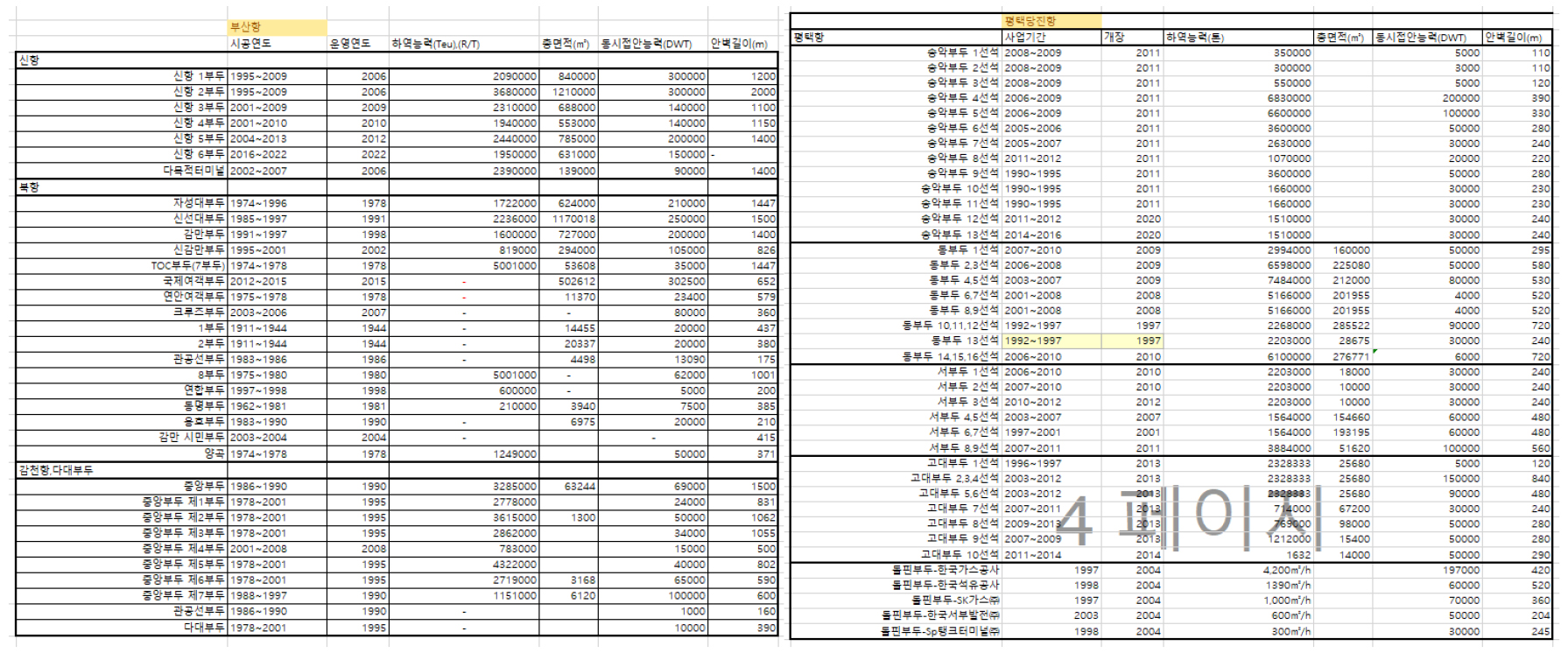
Fig. 3.
Database of Four Key Elements by Port Terminal in the Port Management Information System (PORT-MIS) (Examples: Busan Port, Pyeongtaek-Dangjin Port)
3. 여러 가지 항만부두 분류법을 통한 결과 비교분석
본 연구에서는 항만운영정보시스템(PORT-MIS)을 통하여 이 데이터를 활용하기 위해 총 3가지의 분류방법을 고찰하였다. 방법 1은(Fig. 4) 모든 부두에 대한 분류로 전체 266부두의 데이터를 정규화 분포 방법을 통하여 같은 항만지역 내에서 시공연도와 운영일자가 비슷한 부두들의 경우 같은 화물전용 주차장을 공유할 것이라는 가정하에 부두 각각의 데이터분석을 통하여 부두 하나만의 유사시설을 조사할 수 있는 분류 방법이다. 방법 1의 경우 컨테이너부두 28부두, 비컨테이너 238부두로 산정되었으며, 다음과 같이 그룹을 형성하였다.
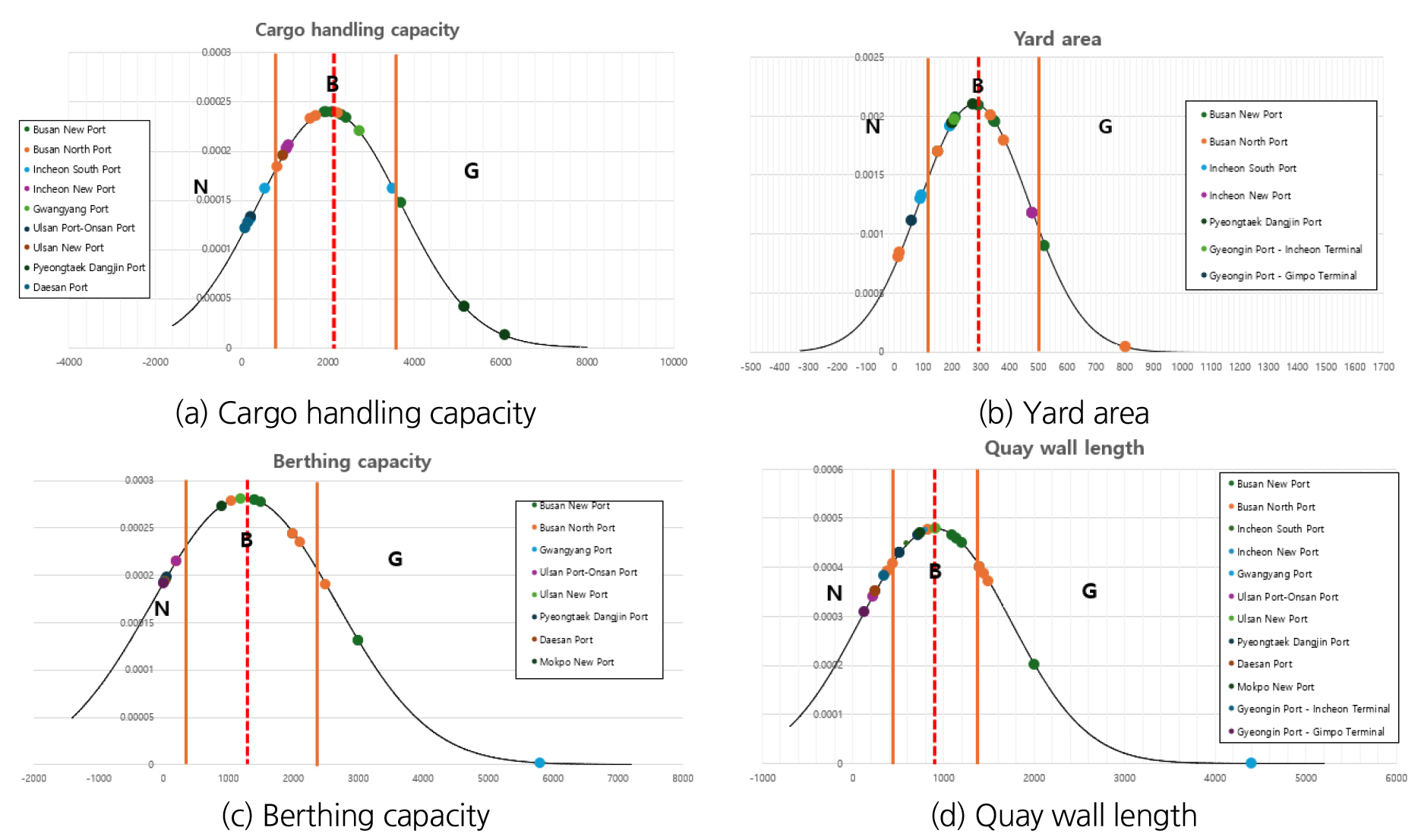
Fig. 4.
Normalization Graph of the Four Key Elements of Ports by Classification Method 1 (All Data)
두 번째 분류방법은 시공연도와 운영일자를 고려하여 ±3년 간격으로 그룹핑을 실시하였다. 같은 항만지역 내 부두시설을 계획할 시 공사계획 기간을 정하고 시공하므로 같은 항만지역 내에서 시공연도와 운영일자가 비슷한 부두일 경우 그 시기에 구축되어 운영하는 같은 화물주차장을 공유할 가능성이 높기 때문에 이와 같은 방법으로 그룹핑을 하여 분류를 실시하였다. 다음(Fig. 5)과 같이 시공연도와 운영일자를 고려하여 그룹핑을 실시 할 경우 총 15개의 그룹으로 나눠진다.
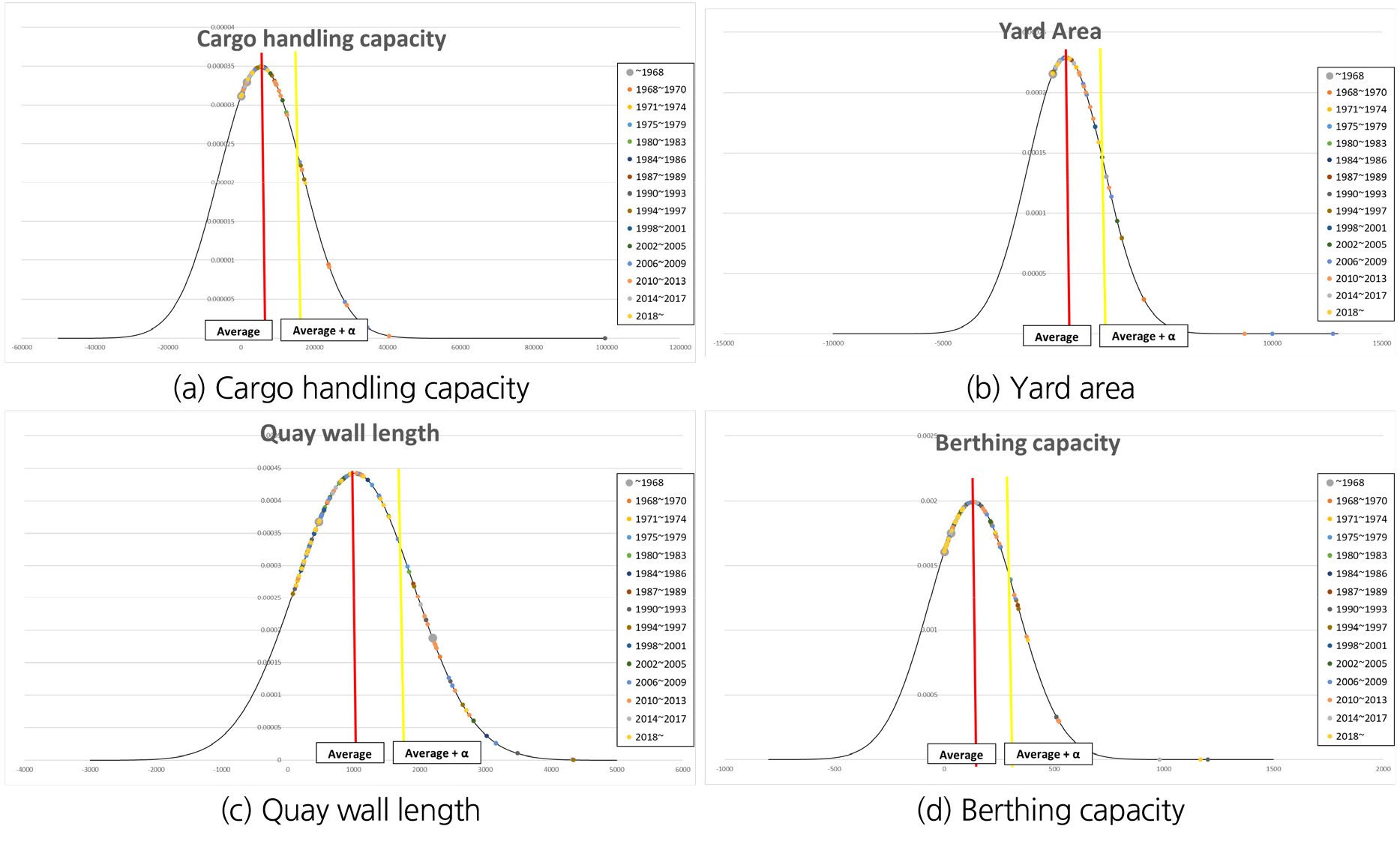
Fig. 5.
Normalization Graph of the Four Key Elements of Ports by Classification Method 2 (Group Considering Construction and Operation Dates)
마지막 분류방법은 항만의 화물주차장을 조사하여 그 주차장을 이용할 가능성이 있는 같은 무역항내 부두별로 그룹핑을 실시하였다. 이 방법은 컨테이너부두에 한하여 그룹핑을 실시하였기 때문에 비컨테이너부두의 경우 추후 연구를 통하여 조사 실시 후 보완되어야 할 것이다.
전국 국가관리 무역항의 컨테이너부두를 보유 중인 항만은 8개 항만(부산항, 인천항, 광양항, 울산항, 평택당진항, 대산항, 포항항, 목포항)이며 컨테이너부두는 28부두로 조사되었다. 컨테이너부두 근처의 화물차전용 주차장은 10개로 조사완료되어 분류방법 3은 Fig. 6과 같이 총 10개의 그룹으로 나눠진다.
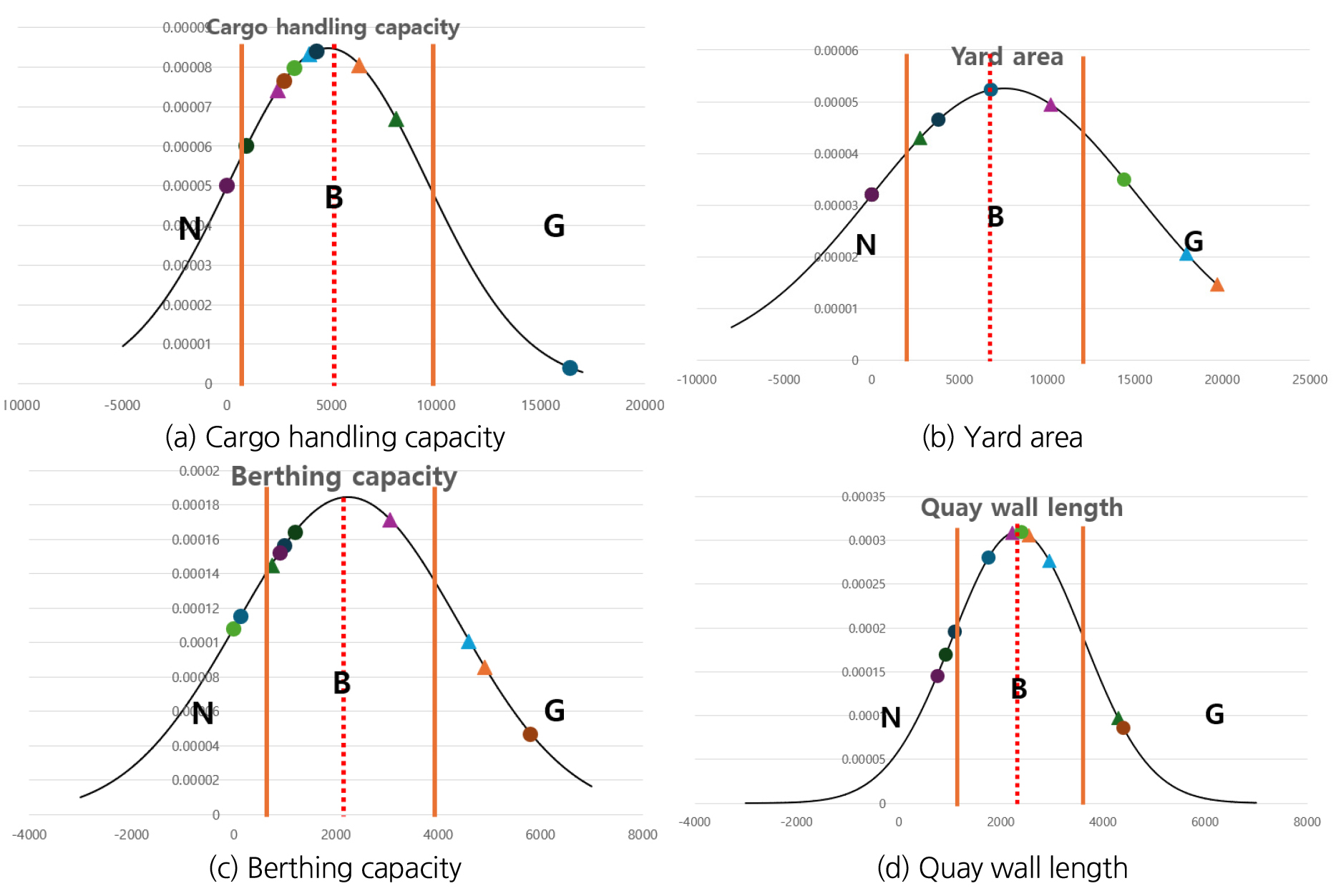
Fig. 6.
Normalization Graph of the Four Key Elements of Ports by Classification Method 3 (Classification of Parking Availability for Freight Truck Parking Lots Near Each Terminal)
4. 결 론
화물차전용 아스팔트포장 주차장 공급필요성에 의해 기존연구에서는 14개의 국가무역항 항만 전체에 초점을 두어 분류방법이 제안되었다. 이때 기존 연구의 항만 전체를 대상으로 한 항만분류 방법은 신설 항만의 부두를 단계별로 설계 시 유사시설 항만 조사를 실시 후 아스팔트포장 주차장을 설계할 때 과소하거나 과대하게 설계될 수 있다는 문제점이 있다.
따라서 화물차 전용 아스팔트포장 주차장설계시 적정한 유사시설 조사를 통한 설계가 이루어질 수 있도록 본 연구에서는 신설항만의 부두 설계 시 유사시설 참고를 위한 새로운 항만분류법 개발을 위한 데이터분석을 실시하였다.
1) 기존의 항만 분류의 경우 국내외 문헌분석을 통해 추출된 여러 항만 능력 중 하역능력, 야적장 면적, 접안능력, 안벽길이 4가지의 능력을 중심으로 항만 분류를 실시하였다. 본 연구에서는 항만이 아닌 항만의 부두에 초점을 맞춰 부두별 4대 요소들을 공공데이터포털에서 제시하고 있는 정보를 통하여 조사하고 DB화를 실시하였다,
2) 본 연구에서는 항만 전체부두의 데이터, 항만 부두별 시공 및 운영시기를 고려한 그룹핑, 항만 화물차전용주차장 활용부두 그룹핑 총 3가지의 그룹핑을 통해 데이터분석을 실시하였다.
3) 데이터분석 결과 3가지의 분류 방법 중 항만 부두별 시공 및 운영시기를 고려하여 그룹핑을 실시한 분류방법이 가장 분류가능성을 가장 높게 평가되었다. 추후 본 연구결과에 이어서 기존 연구결과로부터 설계된 사례와 본 연구결과 설계사례를 비교분석하고, 또한 기존 설계사례중 부적정한 유사시설 조사결과로부터 설계된 사례와 본 연구에서 제시된 분류방법으로 적정하게 조사된 유사시설 조사결과로부터의 비교설계 사례등을 통해 적정성과 적합성을 검증할 예정이다.
4) 화물차전용 아스팔트포장 주차장의 활용도를 고려하여 부두별 근처 화물차주차장의 주차가능성 그룹핑의 방법론 3의 경우 본 연구에서는 컨테이너부두에 한하여 조사되었으므로, 추후 연구로 비컨테이너부두의 화물주차장을 조사하여 데이터분석을 실시하게 된다면 적절한 분석결과를 기대할 수 있을 것이다.
Acknowledgements
본 연구는 해양수산부/항만협회의 지원으로 수행되었으며, 이에 관계자분들께 감사드립니다.
References
Choi, J.S., Jin, H.H., Lee, J.J. and Hong, S.H. (2022). "A study on the Design Methodology for Port Truck Parking Lot through Analysis of Existing Design Cases", Journal of the Korean Asphalt Institute, 12(2), pp. 316-326.
Choi, J.S., Kim, S.J., Seo, J.S. and Lee, J.J. (2023). "Development of parking lot design manual for cargo vehicle parking lot design in port", JOURNAL of the Korean Asphalt Institute, 13(2), pp. 289-294.
Choi, Y. (2018). "A Study on the Change of Port Management System and Volume of Port in China", The Graduate School of Chung-Ang University.
Keum, J.S., Youn, M.O. and Yang, W.J. (2000). "A Study on the Classification of Ports and its Characteristics using Fuzzy C-Means", Journal of Korean Port Research, 14(2), pp. 143-154. (in Korean)
Ministry of Oceans and Fisheries, (2020.12.30). 4th National Port Basic Plan ('21-'30).