


1. Introduction
2. Material preparation and testing work
2.1 Material preparations
2.2 In-Direct Tensile (IDT) mixture creep test
3. Computation of Thermal Stress (TS) with simple Power law function Transformation Approach (PTA) procedure
4. Data analysis (with visual inspection)
5. Summary and conclusion
1. Introduction
It is well known that low temperature cracking: shows similarity to the transverse cracking on the pavement surface, in one of the serious distresses on asphalt pavement especially for northern U.S., Canada and South Korea (Moon, 2010; Moon, 2012; Falchetto et al., 2014; Moon et al., 2014). After low temperature cracking happens water and moisture can easily be infiltrated into asphalt pavement layer which leads to further serious pavement distress such as macro cracking, fatigue cracking and pot hole issues (Marasteanu et al., 2009; Moon, 2010; Moon, 2012).
Due to this reason, many pavement agencies and universities in U.S. and Canada put lots of effort to maintain asphalt pavement at certain level especially at cold weather session (Moon, 2010; Moon, 2012; Falchetto et al., 2014; Moon et al., 2014). To estimate (and/or predict) the severity of low temperature cracking on asphalt pavement, computation of Thermal Stress (TS) is essential (Moon, 2010; Moon, 2012; Falchetto et al., 2014; Moon et al., 2014). Generally, low temperature creep testing with complicated mathematical works are needed for TS computation (Moon, 2010; Moon, 2012).
A simple performance test named Bending Beam Rheometer (BBR) test is used for measuring low temperature creep properties for asphalt binder based on current AASHTO specification (AASHTO, 2012). For asphalt mixture, In-Direct Tensile (IDT) test (Buttlar and Roque, 1994; AASHTO, 2003) is widely used for measuring low temperature creep properties. First, deflection: δ(t), under constant loading condition (e.g. for BBR creep test: 240 seconds and for IDT creep test: 1,000 seconds) is measured for the certain duration of testing procedure. Secondly, creep compliance: D(t) and corresponding creep stiffness: S(t) results are generated using Euler-Bernoulli beam theory based on measured δ(t) results (Findley, 1976; Ferry, 1980). Thirdly, relaxation modulus: E(t), is computed by applying several inter-conversion techniques such as Hopkins and Hamming’s algorithm (1967) (Park and Kim, 1999). Finally, Thermal Stress (TS): σ(T°), is computed by using various mathematical (and/or numerical) approaches with viscoelastic theory (Marasteanu et al., 2009; Moon, 2010; Moon, 2012; Moon et al., 2014). The most complicated computation part on TS computation is the inter-conversion procedure between D(t) and E(t). Because of this computation complexity, not many pavement agencies and universities could derive and apply TS results of asphalt material easily before.
In this paper, a simple Power-law function Transformation Approach (PTA) procedure for TS computation was developed and introduced. Two asphalt mixtures with In-Direct Tensile (IDT) testing was considered for experimental work. The final computation results (i.e. generation of TS results trend) were visually inspected then the findings and future research topics were discussed.
2. Material preparation and testing work
2.1 Material preparations
Two different types of asphalt mixture were prepared by means of Superpave Gyratory Compactor (SGC) with one type of asphalt binder (AASHTO, 2010) for performing simple experimental work. Table 1 presents brief mixture design information of prepared asphalt mixtures in this paper. First, all the asphalt mixture specimens were prepared in Korea Expressway Corporation Pavement Research Division (KECPRD) based on the current asphalt pavement material specification in Korea (MOLIT, 2017). All the prepared materials in KECPRD were then sent to ISBS (Germany) for further experimental works.
Table 1.
Prepared asphalt materials
2.2 In-Direct Tensile (IDT) mixture creep test
In-Direct Tensile (IDT) test was applied for measuring low temperature creep performance (e.g. creep compliance and creep stiffness) of given asphalt material (Buttlar and Roque, 1994; Zhang et al., 1997; AASHTO, 2003). In this test, cylinder shaped asphalt mixture specimen contains dimension of 150±3 mm (diameter)×40±3 mm (thickness) is prepared from SGC (AASHTO, 2010). Then total four Linear Variable Differential Transducers (LVDTs) are used to estimate the vertical and horizontal displacements for 1000±2.5 seconds with application of constant load approximately equal to 7.0~8.5 kN. Figs. 1 to 2 and Table 2 present laboratory work set up and corresponding information of IDT test, respectively.


Table 2.
Information of IDT (In-Direct Tensile) mixture creep test
| Mixture number | Testing temp. [℃] | Number of specimens | Applied load [kN] |
| A | -6, -18 | 3 (-6℃), 3 (-18 ℃) | 7.0~8.5 |
| B | -6, -18 | 3 (-6℃), 3 (-18 ℃) | 7.0~8.5 |
The creep compliance: D(t), and corresponding creep stiffness: S(t),
In IDT test, the creep compliance: D(t) is calculated as (Zhang et al., 1997):
where, D(t) = Creep compliance, 1/MPa;
S(t) = Creep stiffness, MPa (=1/D(t));
= Measured horizontal deflection at time t, mm;
d = Diameter of specimen (=150 mm, prepared from SGC);
t = Thickness of specimen (=40 mm, prepared from SGC);
GL = Gauge Length (=38 mm);
P = Constant applied load, kN(=7.0~8.5);
εx = strain in horizontal direction, mm/mm;
εy = strain in vertical direction, mm/mm;
The computed D(t) (or S(t)) in Eq. (1) is further used to compute Thermal Stress: σ(T°C), which will be mentioned in the next section.
3. Computation of Thermal Stress (TS) with simple Power law function Transformation Approach (PTA) procedure
It is well known that creep compliance: D(t), and relaxation modulus: E(t), are inter-related through convolution integral as can be seen in Eq. (2),
| $$\begin{array}{l}\int_0^t{E(t-\tau)\cdot D(t)d\tau}=\int_0^t{E(t-\tau)\cdot\frac1{S(t)}d_\tau}=t\\\int_0^t{E(t)\cdot D(t-\tau)d\tau}=\int_0^t{E(t)\cdot\frac1{S(t-\tau)}d_\tau}=t\end{array}$$ | (2) |
Moreover, it was found that D(t) (=1/S(t), see Eq. (1)) and corresponding E(t) can be expressed well with Power-law function based on several experimental efforts as can be seen in Eq. (3) (Ferry, 1980; Park and Kim, 1999; Moon et al., 2019):
| $$E(t)\cong E_1\cdot\frac1{t^n}=E_1\cdot t^{-n},\;D(t)\cong D_1\cdot t^n$$ | (3) |
The new method for computation of Thermal Stress (TS) with simple Power law function Transformation Approach (PTA) introduced in this paper can be explained as the following steps:
Perform Laplace transformation on Eq. (3) then get the following expression as can be seen in Eq. (4):
In Eq. (4), Γ is the Gamma function which can be expressed as:
| $$\Gamma(n)=\int_0^\infty t^n-1\cdot e^{-t}dt$$ | (5) |
Based on Eqs. (2) to (5) with Euler reflection formula, the inter-relationship between E(t) and D(t) can be as:
In Eq. (6), parameter n can be expresses as:
| $$n={\left|\frac{\mathrm d\;\log D(T)}{\log\tau}\right|}_{\tau=t}\;\mathrm{or}\;n={\left|\frac{\mathrm d\;\log E(T)}{\log\tau}\right|}_{\tau=t}$$ | (7) |
Therefore, based on PTA approach, E(t) of given asphalt material at low temperature can be expressed as:
| $$E(t)=\frac1{D(t)}\cdot\frac{\sin(n\cdot\pi)}{n\cdot\pi}$$ | (8) |
Then E(t) master curve can be constructed based on experimental results from Table 2 as:
| $$E(t)=E_g\cdot\left[1+\left(\frac t{t_c}\right)^v\right]^\frac wv\Rightarrow LogE(t)=LogE_g-\frac wv\cdot Log\left[1+\left(\frac t{t_c}\right)^v\right]$$ | (9) |
where, Eg = glassy modulus, assumed equal to 30~40 GPa for asphalt mixtures (Moon et al., 2014),
tc, v and w = fitting parameters.
aT = horizontal shift factor which can be expressed as:
| $$a_T=10^{C_1+C_2\cdot T_s}\;\Rightarrow\mathrm{Log}a_T=C_1+C_2\cdot T_s$$ | (10) |
C1, C2 = constant parameters, and
Ts = reference temperature (°C, in this paper lowPG+10°C was set as reference temperature).
Finally, TS: σ(T°C), is computed by solving Eq. (11) in the reduced time domain with 24 Gauss points integration approach at temperature (T°C) ranging from 22°C(=Ti°C) to -40°C. In this paper, a cooling rate of 2°C/hour was considered (Moon, 2010; Moon, 2012, Moon et al., 2014).
where,
| $$\xi=\frac t{a_T}=\;\mathrm{reduced}\;\mathrm{time}$$ | (12) |
= strain rate which can also be expressed as:
| $$\varepsilon(t)=\;\alpha\cdot\triangle T$$ | (13) |
α = Coefficient of thermal expansion or contraction on asphalt mixture; in this study, it is assumed α = 0.00003 (Moon, 2010; Moon, 2012; Moon et al., 2014),
ΔT = temperature cooling rate.
4. Data analysis (with visual inspection)
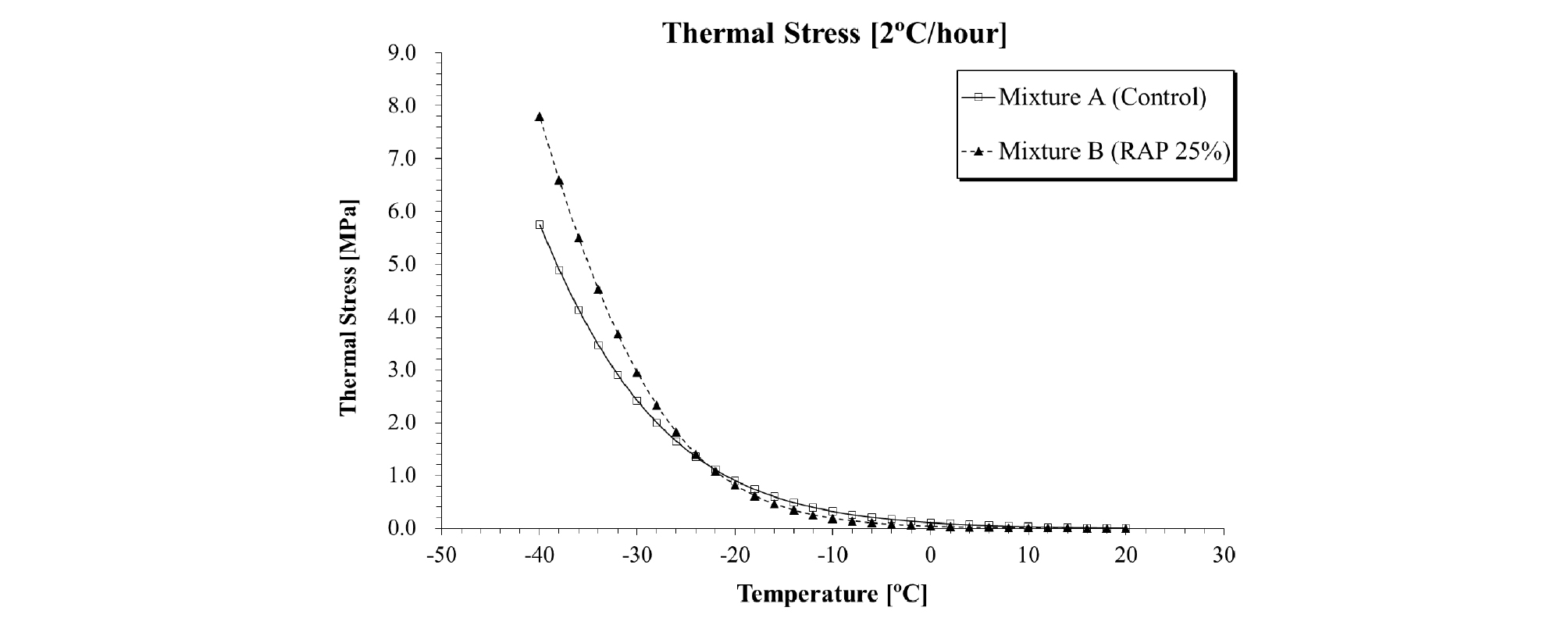
Based on the experimental work (see Section 2) and mathematical computation approach (see Section 3), TS: σ(T°C), of two sample asphalt mixtures was computed then generated. All the computed results are presented in Fig. 3.
It is well known that results of TS from certain viscelastic material such as asphalt mixture shows steep increasing trend when temperature drops less than -10°C (Moon, 2010; Moon, 2012; Moon et al., 2014). In Fig. 3, it can be found that an introduced mathematical approach for computing TS: PTA procedure, can provide reliable and reasonable TS results generation of given asphalt material. However, only limited asphalt mixture specimens were used in this paper therefore, more extensive laboratory and numerical studies are needed as a future research.
5. Summary and conclusion
In this paper, feasibility of applying a mathematical approach: simple Power-law Transformation Approach (PTA) for computing Thermal Stress (TS) of given asphalt mixture was evaluated. As an experimental work, IDT creep testing with two different asphalt mixture preparation was considered. As a result, the simple approximated mathematical approach: PTA procedure, was able to provide reliable and reasonable TS computation results of tested asphalt mixture. However, only limited experimental work and corresponding asphalt mixtures were prepared in this paper. More extensive experimental and mathematical works are needed to further verify findings in this paper as a future research topic.