


1. Introduction
2. Material Preparation Process
3. Experimental Work
4. Thermal Stress Computation Procedure
5. Data Analysis and Comparison
6. Summary and Conclusions
1. Introduction
One of serious distresses on asphalt pavement is: thermal cracking issue (Marasteanu et al., 2009; Moon, 2010, 2012). During an extremely cold weather session, the temperature drops in restrained asphalt pavement layer. Secondly, thermal stress starts developing in the restrained pavement payer. When temperature drops and exceeds the critical temperature cracking level crack ignition: low temperature cracks, starts (Marasteanu et al., 2009; Moon, 2010, 2012). After thermal cracks occur, water and moisture can easily be infiltrated and this leads to destruction of existing pavement layer (Marasteanu et al., 2009; Moon, 2010, 2012).
It is widely known that thermal stress of bituminous material (i.e. asphalt pavement material) can be computed by means of creep testing (Marasteanu et al., 2009; Moon, 2010, 2012). Generally, two testing mtehods: Bending Beam Rheometer (BBR) (AASHTO, 2005; Marasteanu et al., 2009) and Indirect Tension (IDT) method (AASHTO, 2003) are used for measuring creep performance of given asphalt material.
In these testing methods, creep stiffness: S(t), is computed firstly. Secondly, S(t) value is concerted into relaxation modulus: E(t). Finally, thermal stress: , is generated through simple numerical analysis and mathematical modeling work. In the previous research work, the feasibility of applying BBR mixture creep test as an alternative of conventional IDT creep testing was considered (Marasteanu et al., 2009; Moon, 2010, 2012).
However, checking the feasibility of BBR mixture creep testing is still needed. Therefore, conventional IDT testing work was considered in this paper.
2. Material Preparation Process
Total five different asphalt materials were prepared from MnROAD testing cell (Johnson et al., 2009) in this paper. Among these materials, several special materials such as: Warm Mix Asphalt (WMA), Reclaimed Asphalt Pavement (RAP) and other agents are included. Table 1 presents the schematic information of prepared material (Johnson et al., 2009; Marasteanu et al., 2009).
3. Experimental Work
In this paper, conventional IDT creep test was considered. The detailed information is shown in Fig. 1, Tables 2 and 3.
In IDT mixture creep test, creep stiffness: S(t), can be derived as:
Where, J(t) = creep compliance, 1/MPa;
= Measured horizontal deflection at time t, mm;
= Diameter of specimen (150 mm);
= Thickness of specimen (40 mm);
= Gauge Length (38 mm);
= Constant applied load, kN;
= strain in horizontal direction, mm/mm;
= strain in vertical direction, mm/mm;
In Eq. (1), the compliance parameter: C, can be expressed as (see Eqs. (2) and (3)):
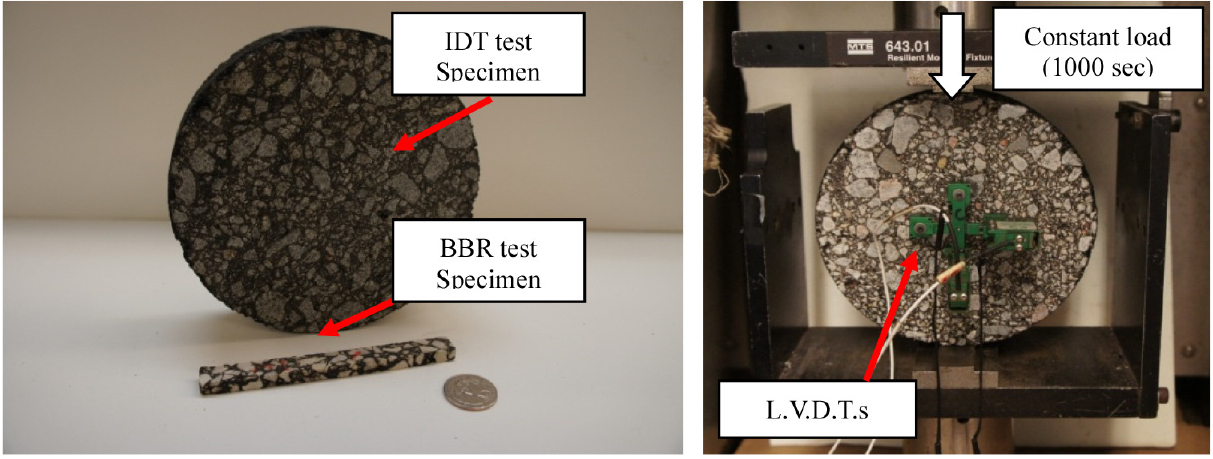
Table 2.
Information of testing methods
Table 3.
Summary of IDT mixture testing information
4. Thermal Stress Computation Procedure
As mentioned in the introduction section, the thermal stress is one of key components in current AASHTOWare Pavement design guide (AASHTO, 2025) on estimating the performance of asphalt pavement. It is mentioned that thermal stress develops in a restrained asphalt pavement layer which can be represented as an uniaxial viscoelastic beam shape. Thermal stress can be computed the following equation (see Eq. (4)):
= time dependent stress, and = relaxation modulus
The strain, , is re-expressed as (see Eq. (5)):
Where, = coefficient of thermal expansion or contraction,
= temperature change rate;
The reduced time () expressed as:
In Eq. (6),
= time (sec), = shift factor and = relaxation time
Finally, the thermal stress, , can be computed as follows:
In this paper, the following procedure was used to compute :
1. Creep compliance, J(t), was obtained from IDT testing.
2. E(t) was calculated from J(t) using Hopkins and Hamming (1957) algorithm.
3. E(t) master curve was generated using CAM model (Basu, 2002; Moon 2010, 2012):
In Eq. (8),
= Glassy modulus (assumed 3GPa for binder and 30GPa for mixture);
, and = fitting parameters
In Eq. (9),
and = constant parameters, = reference temperature, °C;
In addition, Eqs. (7) and (8) were solved numerically using Gaussian quadrature with 24 Gauss points (Basu, 2002; Moon 2010, 2012).
Finally, the thermal stress results (i.e. solving Eq. (7) numerically) from BBR and IDT tests were compared visually. Moreover, the values of cooling rate of asphalt binder were set as: 1 Celsius (= Degree)/hour and 10 Celsius (= Degree)/hour in this paper, respectively.
5. Data Analysis and Comparison
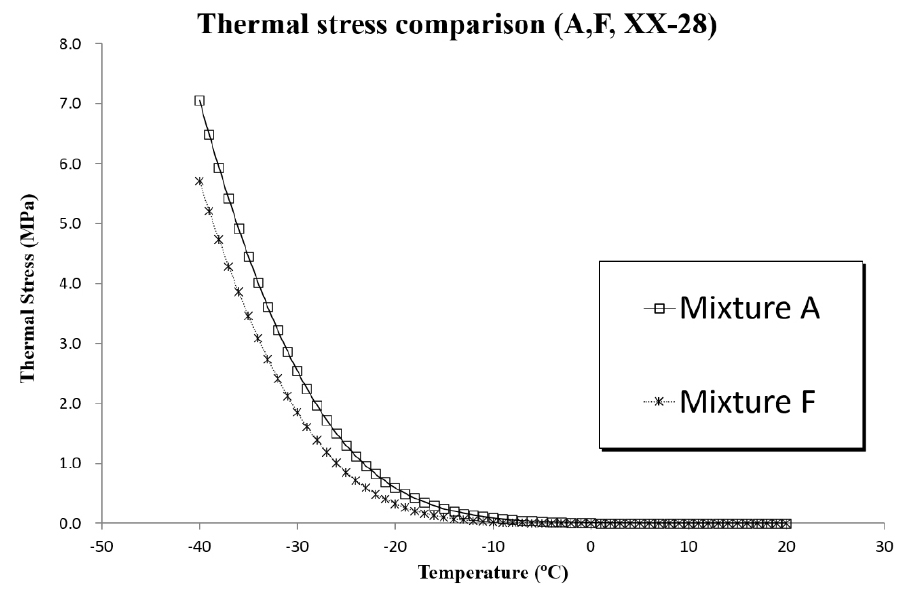
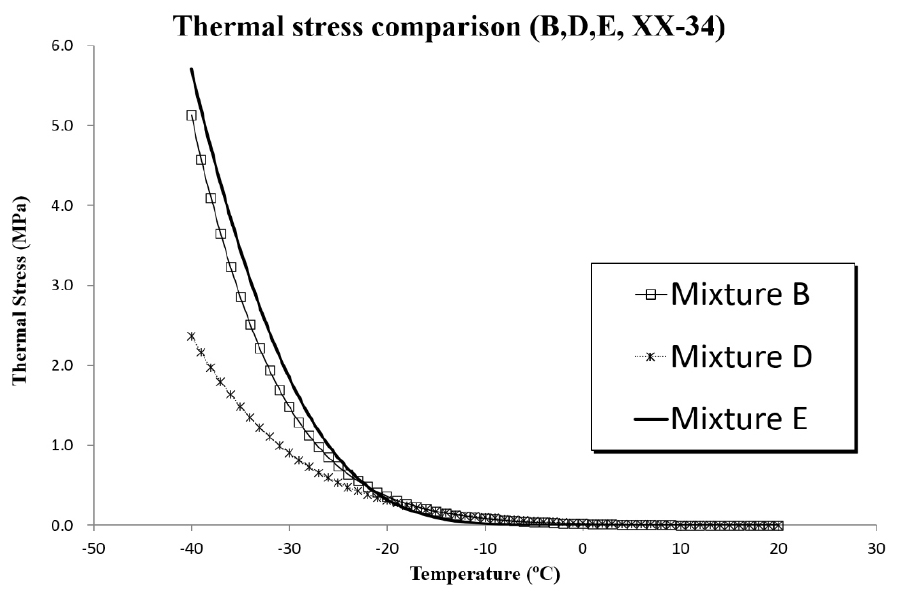
All the computed results of thermal stress (i.e. mixtures A to F) are shown in Figs. 2 and 3.
From the results in Figs. 2 and 3, some crucial findings can be derived. First, thermal stress can be a useful criterion for measuring low temperature performance of given bituminous material such as asphalt mixture (and/or corresponding binder). This thermal stress value can also be used for tool for evaluating RAP usage (see Fig. 2). Compared to the control mixture (i.e. Mixture A), non fractioned RAP mixture (i.e. Mixture F). It is well known that more brittle characteristics at low temperature condition are found on RAP mixture compared to the conventional asphalt mixture. However, opposite results were found in this paper which supports the feasibility of RAP application in actual asphalt pavement area. More extensive experimental works along with mathematical analysis procedures are needed in this paper to further verify the findings in this paper. It also can be found that WMA shows a possibility for applying in the actual asphalt pavement field (see Fig. 3). Even though one mixture (i.e. Mixture F) showed higher values of thermal stress compared to the control mixture (i.e. Mixture B), other WMA mixture (i.e. Mixture D) presented relatively lower thermal stress in comparison with mixture B. This indicates the feasibility of WMA mixture application in asphalt business. Similar to the previous paragraph, more extensive experimental works (i.e. including BBR mixture creep test results consideration) and analysis procedures should be considered to further strengthen the findings in this paper.
6. Summary and Conclusions
In this paper, low temperature performance of given asphalt materials was evaluated by means of IDT mixture creep testing. To compute thermal stress results, creep stiffness, relaxation modulus, model fitting and numerical analysis procedures were considered. As a results, it was found that thermal stress can be a crucial criterion tool for evaluating low temperature of given asphalt material including RAP and WMA mixtures, successfully. However, lack of material specimens and considering only one performance test is still the limits in this research paper. More extensive experimental works along with material preparations and mathematical analysis approaches are recommended in the future study to further strengthen the original findings in this paper.