


1. Introduction
2. Information on experimental work (BBR creep test)
3. Relaxation modulus: E(t), conversion approaches
3.1 Simple power law function approach
3.2 Hopkins and Hamming’s algorithm (1967)
4. Data analysis
5. Summary and conclusions
1. Introduction
Thermal cracking is a crucial distress for asphalt pavements especially in northern U.S. and Canada (Moon, 2010; Moon et al., 2013). When temperature drops below 0°C, thermal stress originated and increase in the restricted asphalt layers. When the temperature drops below a limit value known as critical temperature, finally low temperature cracking occurs (Moon, 2010; Moon et al., 2013). Low temperature cracking is source of significant negative effects on asphalt pavement performance; due development of surface cracks (i.e. including micro and macro cracks) water infiltration in pavement structure occurs. Finally, this leads significant pavement deteriorations (e.g. low temperature cracking, large pavement deformation etc.) which provide crucially negative effects to its users (Marasteanu et al., 2009; Moon, 2010).
Due to this reason, many road agencies are trying considerable efforts to maintain asphalt pavement performances and network systems at acceptable levels (Cannone Falchetto et al., 2014). Various experimental approaches have been introduced during the past decades to characterize the low temperature behavior (e.g. viscoelastic characteristics) of bituminous materials (Marasteanu et al., 2009; Moon, 2010; Moon et al., 2014; Cannone Falchetto et al., 2014). One good example is the low temperature creep test (Marasteanu et al., 2009; Moon, 2010; AASHTO T313-12, 2012). On this experimental test, creep stiffness: S(t), creep compliance: J(t) can be easily computed based on current specification (AASHTO T313-12, 2012). Then an important material performance criterion, relaxation modulus: E(t), can be calculated by means of different mathematical approaches (Moon, 2010; Moon et al., 2013; Cannone Falchetto et al., 2014). However, not many studies have considered the numerical comparisons of E(t) results.
In this paper, two different mathematical approaches (e.g. power law transfer function and Hopkins & Hamming’s algorithm) were considered to convert J(t) to E(t). As an experimental work, Bending Beam Rheometer (BBR) low temperature creep test was considered (AASHTO M320-10, 2010; AASHTO T313-12, 2012). Then the relaxation modulus: E(t), results were analyzed and compared visually to derive engineering meanings.
2. Information on experimental work (BBR creep test)
Two different asphalt binders were prepared in this paper (e.g. one is original tank binder and the other one is modified binder). More detailed information on the prepared materials is shown in Table 1.
Table 1.
Prepared asphalt binders
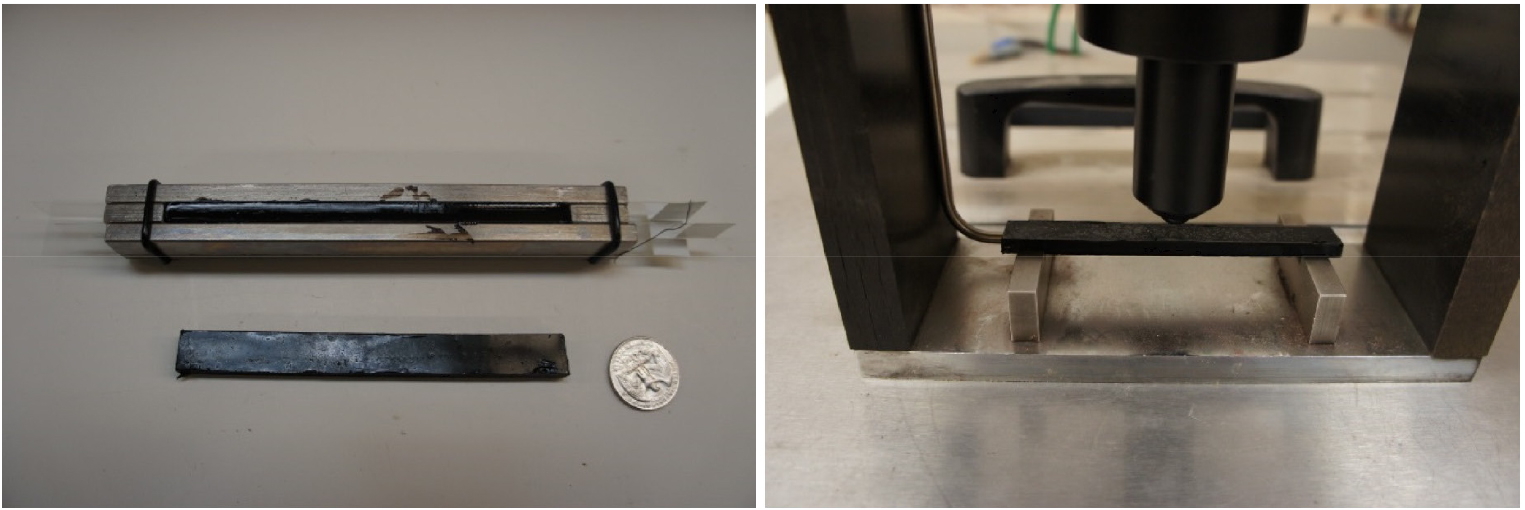
In BBR creep test (AASHTO T313-12, 2012, see Fig. 1), low temperature creep stiffness: S(t), can be computed as follows:
1) BBR creep tests were performed on thin asphalt binder beams (102.0 ± 5 mm × 12.7 ± 0.5 mm × 6.25 ± 0.5 mm) according to the current AASHTO specification (AASHTO T313-12, 2012).
2) In BBR creep test, the mid-span deflection, (t), of an asphalt binder specimen is measured for the entire duration of the test (total = 240 s), then the creep stiffness, S(t) and the m-value (slope of logarithmic S(t) vs time curve) can be computed as:
3) In Equations (1) and (2), S(t) is the flexural creep stiffness; D(t) is the creep compliance; σ is the maximum bending stress in the beam; ε(t) is the bending strain; P is the constant applied load (980 ± 50 mN); l is the length of specimen (102 ± 5 mm); b is the width of specimen (12.7 ± 0.5 mm); h is height of specimen (6.25 ± 0.5 mm); (t) is the deflection at the mid-span of the beam, and t is testing time (0~240 s).
4) Then, relaxation modulus: E(t), was computed based on computed S(t) (and/or D(t)) and compared visually. It needs to be mentioned that computation of E(t) is crucial because results of E(t) can be moved on to thermal stress calculation: one of significant low temperature properties of asphalt material especially at low temperature condition.
3. Relaxation modulus: E(t), conversion approaches
Conventionally, J(t) and E(t) can be inter-related by means of the convolution integral as (Findley et al., 1976; Ferry, 1980; Moon, 2010; Moon et al., 2013):
where t > 0
Through Laplace transformation application, Equations (3) or (4) can be re-expressed as:
where s > 0 is the Laplace transformation parameter.
However, in many cases the expressions for E(t) and J(t) cannot be easily computed in the Laplace domain. Therefore, various numerical approaches are considered as an alternative and convenient method for solving the convolution integral in Equations (3) and (4).
3.1 Simple power law function approach
In previous researches, it was found that values of J(t) and E(t) can be interrelated through a simple power-law functions as follows (Ebrahimi et al., 2014):
where E1, J1 and n are positive constants. With applications of Laplace transformation approach and Euler reflective formula, E(t) and J(t) can be inter-related as (see Equations (8) and (9)):
where parameter n can be expressed as:
These power-law approximation methods provide very good results when D(t), and/or J(t), is close to a straight line in a log-log scale plot against time.
3.2 Hopkins and Hamming’s algorithm (1967)
In this paper, a simple numerical algorithm introduced by Hopkins and Hamming (1967) is applied to compute E(t) from J(t). The main computational steps for obtaining E(t) can be summarized:
1) Select a time interval as:
2) Express the integral form of J(t) as:
3) From Equation (11), f(t) can be re-expressed by means of trapezoid integration rule:
4) Equations (10) to (12) can be modified using the above Equation (12) as:
5) From Equation (13), each integral element can be approximated as:
6) Equation (14) can be written as:
7) Solving for , Equation (16) is:
where,
It should be mentioned that Simple Power law method is easy to compute E(t) results however, less on detailed answer. The Hopkins and Hamming’s algorithm can provide more reliable E(t) results but the computation process is a little but complicated.
4. Data analysis
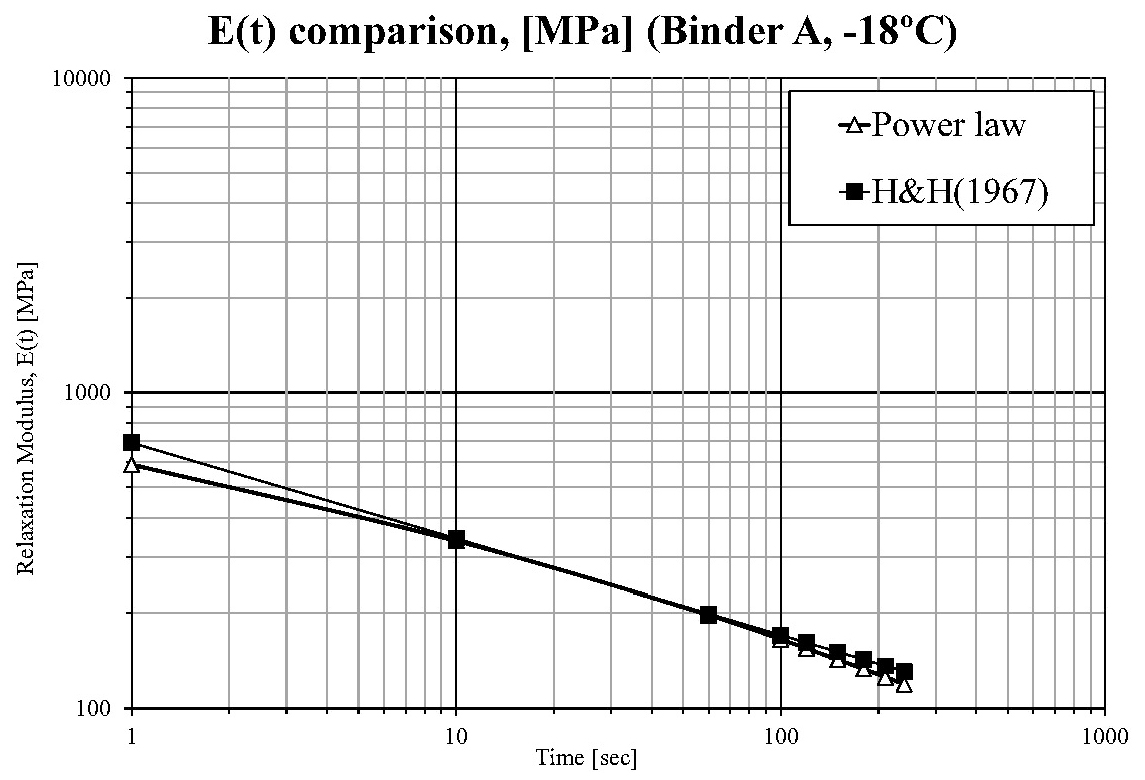
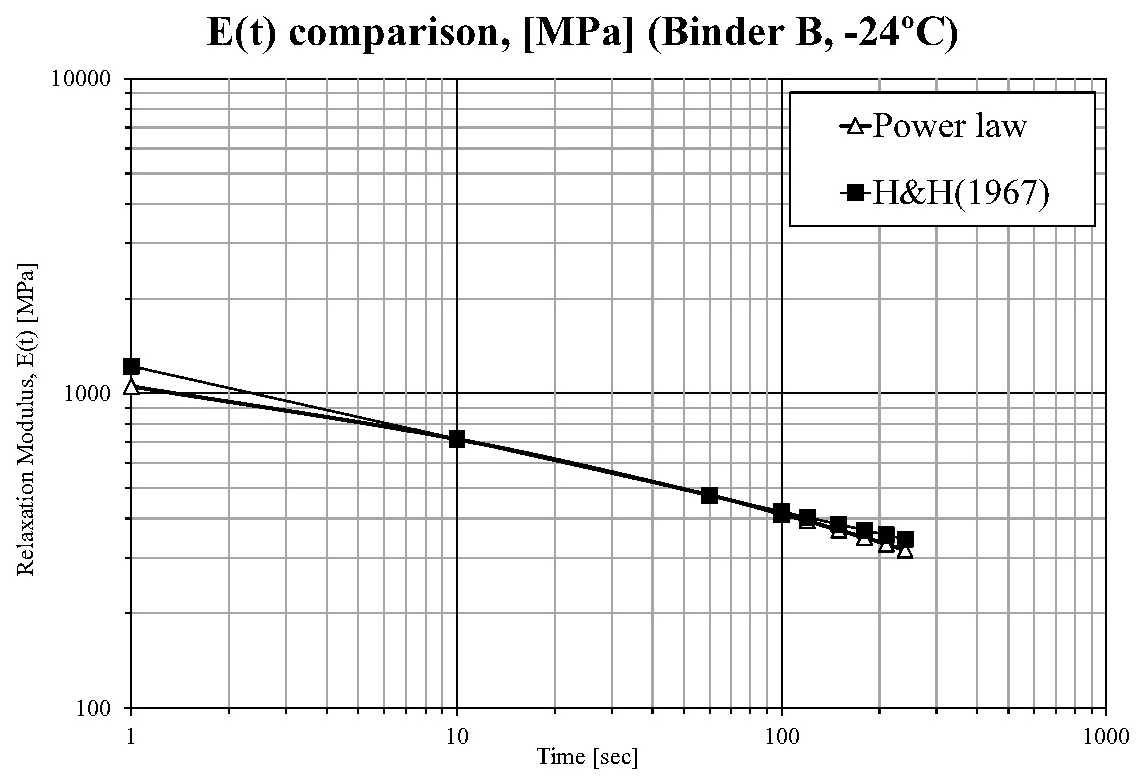
Based on the above theories (i.e. See Section 3), the computed results of E(t) can be presented as follows (i.e. see Figs. 2 and 3).
From the results in Figs. 2 to 3, it was found that the different mathematical approaches can successfully provide upper and lower bounds on E(t) computation working process. This crucial finding can be related to thermal stress computation step and this will be considered as the next research topic.
5. Summary and conclusions
In this paper, different mathematical approaches for relaxation modulus computation on asphalt material were considered. A simple power law function and Hopkins and Hamming’s algorithm was considered. Finally, it was found that successfully upper and lower bounds on relaxation modulus computation was derived. This means reliable range on low temperature performance computation of asphalt material is available by means of different mathematical approaches. More extensive experimental works and further numerical analysis efforts are needed as future research in this paper.