


1. Introduction
2. Research Objective
3. Material Preparations
4. Experimental Testing Protocol
5. Test Results for Asphalt Binder
6. Test Results for Asphalt Mixture
7. Summary and Conclusions
1. Introduction
During the Strategic Highway Research Program (SHRP) many researchers found that the creep stiffness of asphalt binders increases dramatically with conditioning time when they are stored isothermally at low temperatures (Anderson et al., 1994). This phenomenon was previously reported for amorphous polymers using the name of physical aging (Struik, 1978). Struik (1978) presented that physical aging is a basic feature of the glassy state and that it occurs in all glasses, regardless of their chemical nature. He also mentioned that physical aging effects in other glassy materials such as bitumen, shellac, and amorphous sugar. Other studies that followed Struik’s work have also showed physical aging in fully amorphous polymers, in cross-linked network polymers (Lee and McKenna, 1988) and in semi-crystalline polymers (Tant and Wilkes, 1981). These studies showed significant effects due to physical aging on the dynamic moduli (Ogale and Wang, 1989), the yield strength (Legrand, 1969), elongation at break (Petrie, 1976), and impact strength (Heijboer, 1968).
The first comprehensive research of physical aging in asphalt binders was performed during SHRP (Claudy et al., 1992; Bahia and Anderson, 1993; Anderson et al., 1994). Then physical aging was called physical hardening by SHRP researchers to emphasize the thermo-reversible nature of the phenomenon and to avoid confusion with oxidation aging which is used in the asphalt binder literature and which is not reversible (Anderson et al., 1994).
2. Research Objective
The objective of this paper is to investigate if physical hardening affects asphalt mixtures creep stiffness at low temperature and to compare the changes with physical hardening observed in the component asphalt binders. As an experimental work, BBR creep tests were performed on both asphalt binders and asphalt mixtures thin beams at similar temperatures and two conditioning times.
3. Material Preparations
Two types of binder were used in this research. The corresponding asphalt mixtures were design followed the guidelines for a 12.5-mm Superpave mixture with 4 percent air voids level (Marasteanu et al., 2007). All the information of prepared asphalt material is shown in Tables 1 and 2.
4. Experimental Testing Protocol
The laboratory binders were aged according to AASHTO Rolling Thin Film Oven Test (RTFOT) (AASHTO, 2006a) and Pressure Aging Vessel (PAV) procedure (AASHTO, 2006b). Two replicates were tested for RTFOT and one replicate was tested for PAV condition. The mixtures were short term aged according to AASHTO specification (AASHTO, 2009). Asphalt mixture beams of the same dimensions as the BBR binder beams were cut from gyratory cylinders and field cores according to the procedure described in elsewhere (Petersen et al., 1994; Marasteanu et al., 2009). The thickness and width of the thin beams were measured at three locations along the length of the beam and average values were calculated and used in the calculations. The binders were tested according to AASHTO specification (AASHTO, 2006c) with the constant load was equal to 980 mN load. The first set of results was obtained after 1 hour conditioning at the test temperature. After the test was done, the beam was removed from the testing frame and stored in the bath at the same temperature for another 23 hours. Then, the beam was tested again, and the second set of results was generated. The test was performed on the same beam to avoid additional testing variability.
A similar approach was used to test the asphalt mixtures thin beams. A constant load of 4500 mN was used in all mixture testing (Petersen et al., 1994; Marasteanu et al., 2009). At least three replicates of asphalt mixtures beams were tested for mitigating mixture variability issue (Velasquez et al., 2009).
5. Test Results for Asphalt Binder
The analysis of the binder creep stiffness curves indicates that physical hardening is present in the RTFOT and the PAV binder. Examples are shown in Fig. 1 and the results are summarized in Tables 3 to 4 and in Fig. 2.
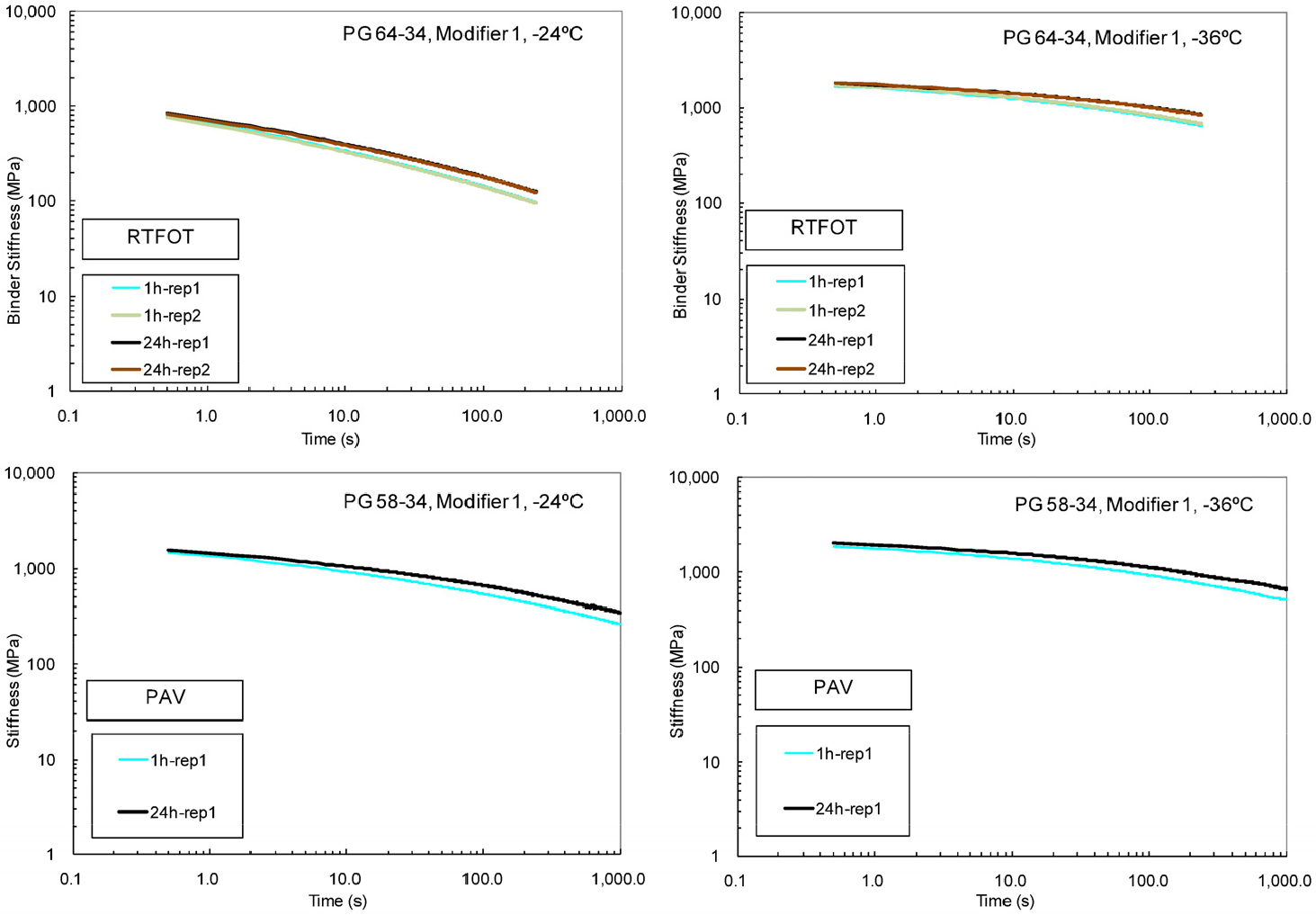
Table 3.
Creep stiffness at 60 s, RTFOT binders
Table 4.
Creep stiffness at 60 s, PAV binders
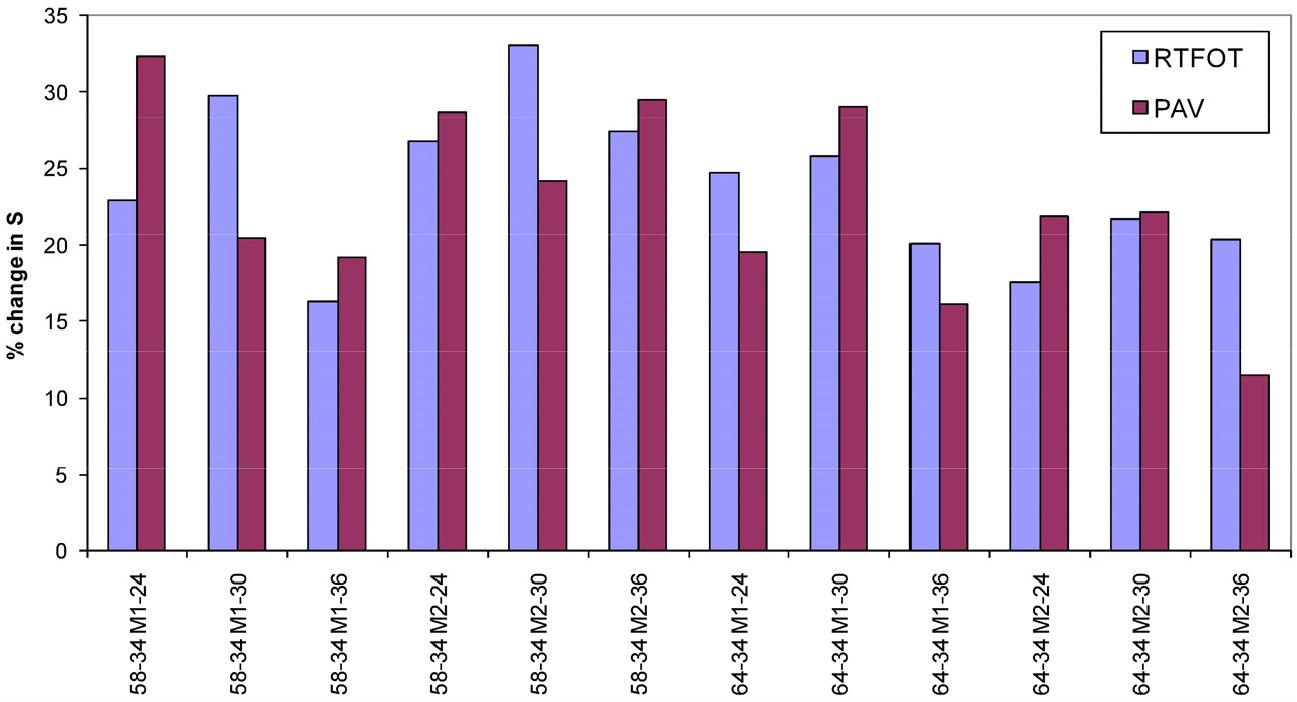
The results show that the additional conditioning time increases the creep stiffness for all asphalt binders tested, regardless of aging condition. The stiffness increases on average by 23.5%, with the highest value at 33%, and the lowest at 11.5%. Percent wise, PAV aging slightly decreases the creep stiffness increase with storage time compared to the RTFOT condition.
6. Test Results for Asphalt Mixture
The analysis of the mixture creep stiffness indicates a more complex behavior, with positive and negative changes in stiffness with conditioning time, which also depends on the aggregate used in the mixture. An example is shown in Fig. 3 for the limestone (LM) and granite (GR) mixtures prepared with PG64-34, modifier 2 binder. Moreover, Table 5 presents the creep stiffness for the laboratory prepared mixtures.
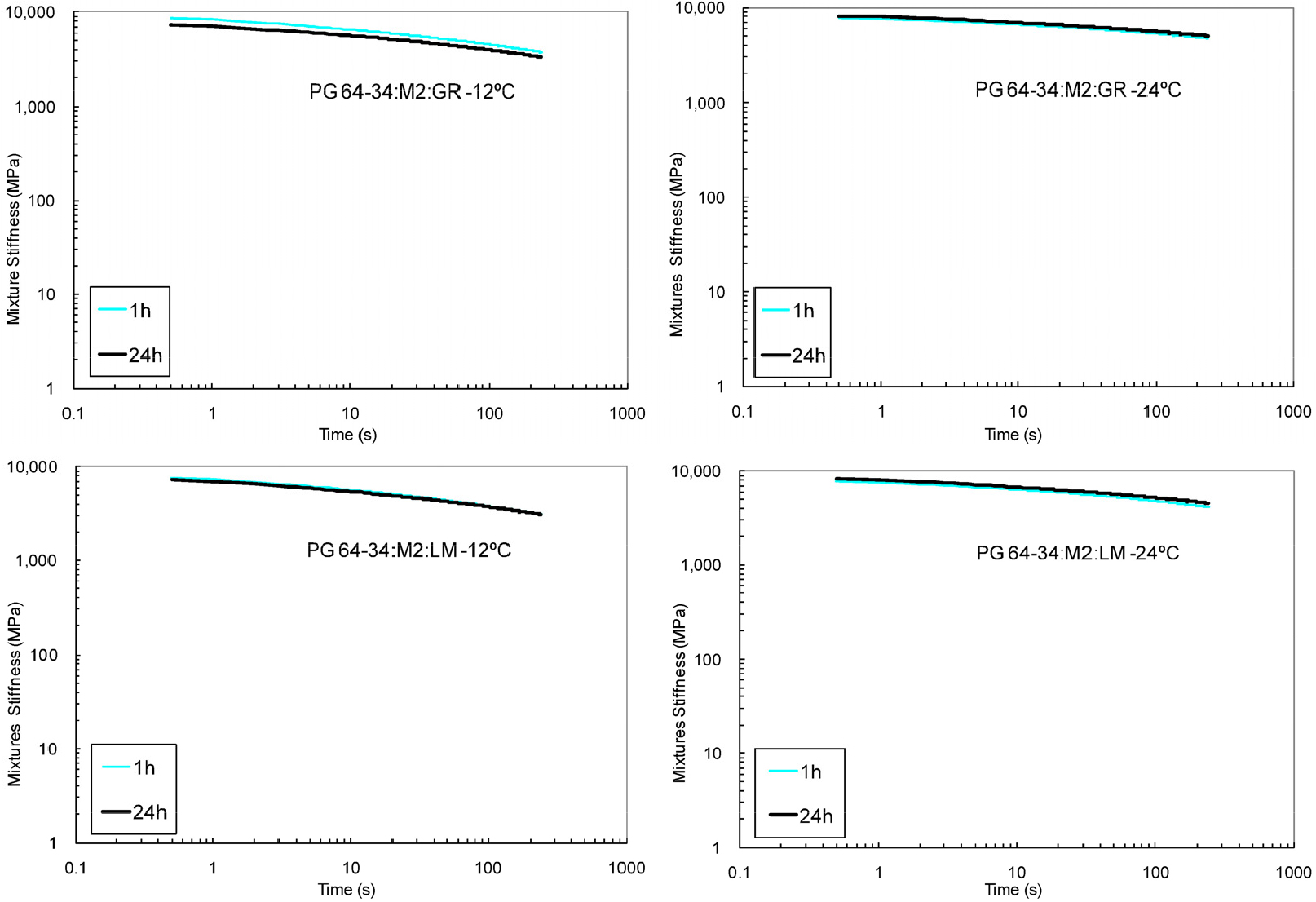
A different trend is observed for the asphalt mixtures prepared in laboratory conditions: for almost half of the mixtures, there is a decrease in creep stiffness with conditioning time. For the mixtures for which there is an increase, the change is significantly less than that observed in the corresponding binders. It can be said that physical hardening effect can be different for asphalt binder and corresponding mixture. Therefore, more prudent results derivation with more extensive research efforts are needed.
Table 5.
Creep stiffness at 60 s, laboratory prepared asphalt mixtures
7. Summary and Conclusions
In this paper, the BBR creep tests were performed on asphalt binder and mixture beams conditioned at test temperature for 1h and 24h to quantify physical hardening effects. For the laboratory aged binders, the additional conditioning time resulted in significant increases in creep stiffness regardless of aging condition. For more than half of the laboratory mixtures, a significantly smaller increase in creep stiffness is observed. Moreover, for the rest of laboratory asphalt mixtures a decrease in creep stiffness is observed. A number of explanations were also provided for why mixture stiffness may decrease with storage time. The effect of physical hardening effect on bituminous material such as asphalt binder and corresponding mixture could be evaluated, verified and predicted in this paper. As a result, this engineering finding can be successfully applied for developing next generation environment friendly asphalt material including recyclable aggregates.
The results of this investigation indicate that additional research is needed to understand the behavior of mixtures stored at low temperature for extended periods of time. It is suggested that acoustic emission techniques should be used in conjunction with mixture physical hardening experiments to monitor and quantify micro cracking activity that may explain the role played by the aggregate components of the mixture. Studies are also needed to investigate physical hardening effects on binder and mixture fracture properties; while mixture creep stiffness is one order of magnitude larger than binder creep stiffness, strength properties are similar, and the localized nature of fracture may lead to similar physical hardening effects in binders and mixtures.