
Scientific Paper

Journal of the Korean Asphalt Institute. 31 December 2024. 324-329
https://doi.org/10.22702/jkai.2024.14.2.30

ABSTRACT


MAIN

  • 1. Introduction

  • 2. Test section and IRI(m/km) testing method

  • 3. Data analysis

  • 4. Conclusions

1. Introduction

The road pavement surface condition is crucial to provide more comfortable driving experience to users (Choubane et al., 2002; Smith et al., 2002; Titi and Rasoulian, 2008). It is well knonw that an even and smoother asphalt pavement surface can contribute on reducing the traffic accident rate and corresponding social costs (McGhee and Gillespie, 2007; Zaabar and Chatti, 2014; Robbins and Tran, 2016). And the well known engineering parameter on evaluating pavement eveness and smoothness is the International Roughness Index (IRI, m/km) (Gillespie et al., 1980; Sayers, 1986; Sayers et al., 1986). The IRI provides significant information on pavement smoothness; the IRI is derived from a mathematical model of a quarter-car vehicle with a simulated vehicle speed of 80 km/h (Gillespie et al., 1980; Sayers, 1986; Sayers et al., 1986). Generally, lower IRI value means better and positive condition on pavement surface condition (Gillespie et al., 1980; Sayers, 1986; Sayers et al., 1986). The current IRI resuirement on South Korea expressway is : less than 1.6 m/km (Gillespie et al., 1980; Sayers, 1986; Sayers et al., 1986).

The construction of asphalt pavement is consisted of three steps : material delivery, material paving and material compaction. Normally, smoothness of asphalt pavement surface is decided in material paving step by means of paving equipment named asphalt pavement finisher (Dalla et al., 2017; Gong et al., 2018).

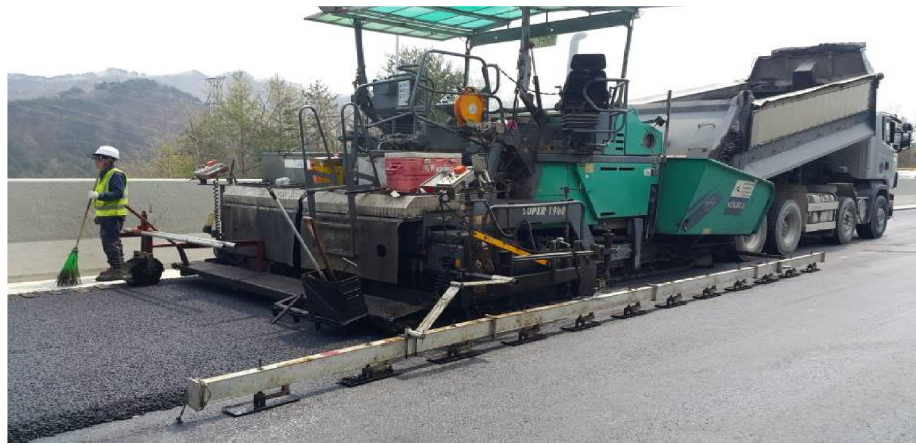
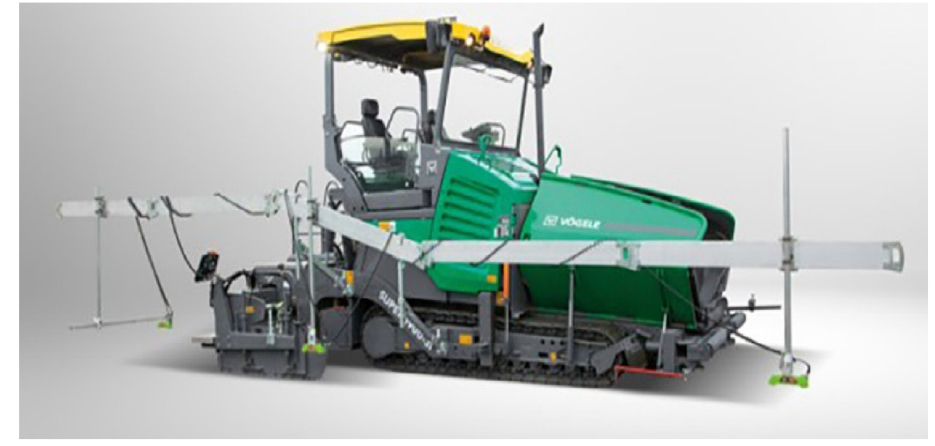
For past decaded, Long Ski (i.e. LS): using long steel plate to control asphalt pavement thickness and smoothness by contacting asphalt pavement surface physically, was widely used not only for Expressway but also county road construction in South Korea and other east asai countries (Bae et al., 2015, 2017, 2018). The LS system is easy to install and use in the construction field. However, the LS system can provide only neutral IRI results (e.g. no less than 1.4~1.5 m/km) and show limitations on lowering IRI value less than 1.2m/km (Bae et al., 2015, 2017, 2018). For this reason, many pavement equipment companies struggled to develop advanced technologies that may enable better surface smoothness of asphalt pavements for many years (Li et al., 2013; Elagamy, 2016; MOBA group, 2022; Writgen group, 2022). Such efforts has finally led to the development of the non-physical contact paving smoothness controlling system named Non-Contact Digital Ski (NCDS) system (MOBA group, 2022; Writgen group, 2022). The NCDS system does not require physical contact between the smoothing equipment and pavement surface. The required thickness of the asphalt pavement layer is automatically adjusted during the paving and 1st compaction procedure by means of a non-contact distance measuring algorithm with multi sonic&acoustic sensors (MOBA group, 2022; Writgen group, 2022). The NCDS system is consisted of three cartridges containing five sensors. The NCDS system can be attached in asphalt paver either one or two sides (i.e. left or right sides). During the paving work procedure, total 15 measured thickness results are reported to paver. After removing highest and lowest results in each cartridge, final 9 measured results are used to construct and adjust asphalt pavement thickness. Figs. 1 and 2 present the convnetional LS system and newly developed NCDS system, respectively. Moreover, the three independent sensor cartridges can be positioned vertucally or horizontally based on various paving work situations.

In other references, the evaluated IRI (m/km) results with NCDS technology is ranged from 0.8 to 1.2 m/km which is significantly better pavement smoothness than the conventional construction method (MOBA group, 2022; Writgen group, 2022).

The research purpose of this paper is : feasibility evaluation of NCDS approach by means of actual asphalt pavement construction and IRI (m/km) testing process.
https://cdn.apub.kr/journalsite/sites/jkai/2024-014-02/N0850140222/images/jkai_2024_142_324_F1.jpg
Fig. 1.

The conventional LS (Long Ski) method

https://cdn.apub.kr/journalsite/sites/jkai/2024-014-02/N0850140222/images/jkai_2024_142_324_F2.jpg
Fig. 2.

The advanced NCDS (Non Contact Digital Ski) method

2. Test section and IRI(m/km) testing method

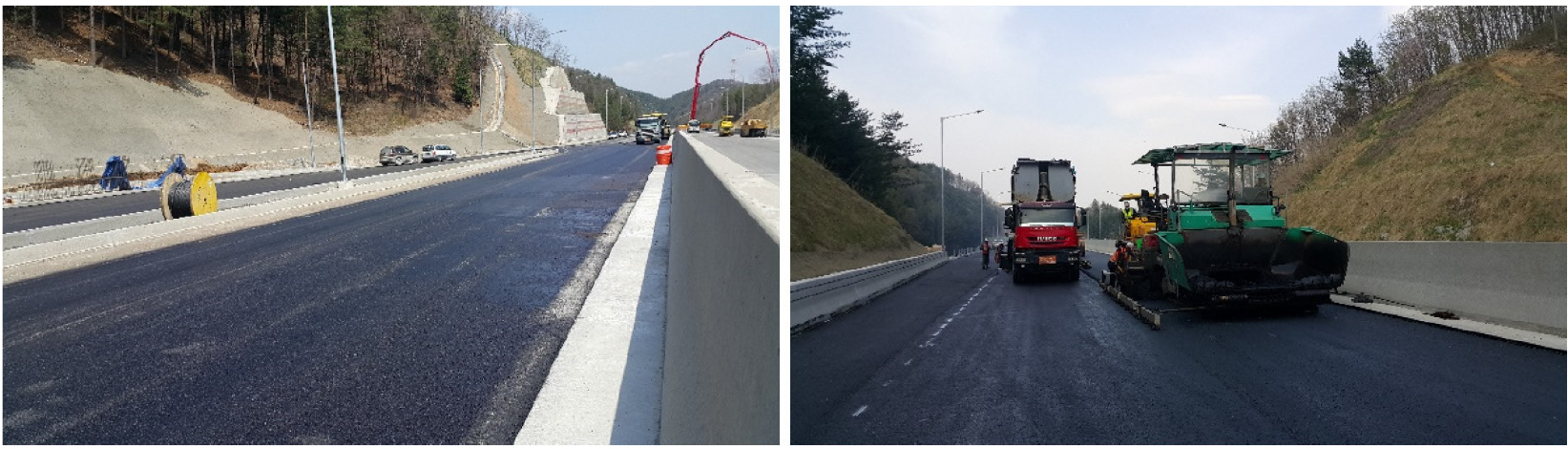
One asphalt pavement constructions section around Kyung Nam in South Korea was selected. More detailed information about the construction section is presented in Table 1 and Fig. 3.

Table 1.

The information about selected construction site (South Korea Expressway)
Expressway (section) Location Pavement structure characteristics
Testing section,
(in South Korea)
Location: Kyung-nam area
(re-construction)
kyung-Boo expressway
Station: 324~326 k
Length = 0.25 km
Lane 1: LS + SL
Lane 2: NCDS
Composite pavement structure
1) Flexible pavement layer
SMA, t = 10 cm, NMAS: 13 mm
(SMA: Stone Mastic Asphalt)
(Air void: 2.0~2.8%, Binder: PG -22)
2) Rigid pavement layer
Concrete (JCP, t = 30 cm)
(JCP: Jointed Concrete Pavement)
(Cement: Ordinary Portland Cement)
(Joint location: every 6 m installation)
3) Chemical stabilized layer
Cemented layer (t = 15 cm)
(Consisted of mortar treated layer)
4) Subgrade
(Clay soil: upper, Gravel: bottom)

https://cdn.apub.kr/journalsite/sites/jkai/2024-014-02/N0850140222/images/jkai_2024_142_324_F3.jpg
Fig. 3.

Picture of actual construction site (Expressway site around Kyung Nam)

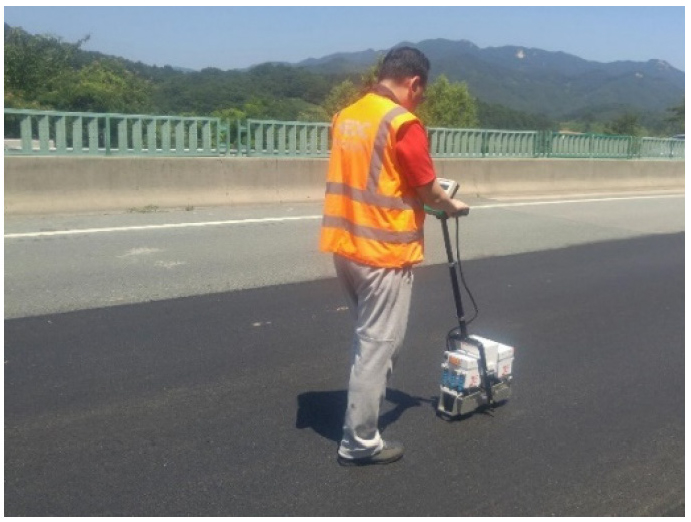
The IRI was measured two times per each testing site by means of professional equipment as can be seen in Fig. 4 (MOBA group, 2022; Writgen group, 2022).
https://cdn.apub.kr/journalsite/sites/jkai/2024-014-02/N0850140222/images/jkai_2024_142_324_F4.jpg
Fig. 4.

Picture of IRI measurement using professional testing equipment

3. Data analysis

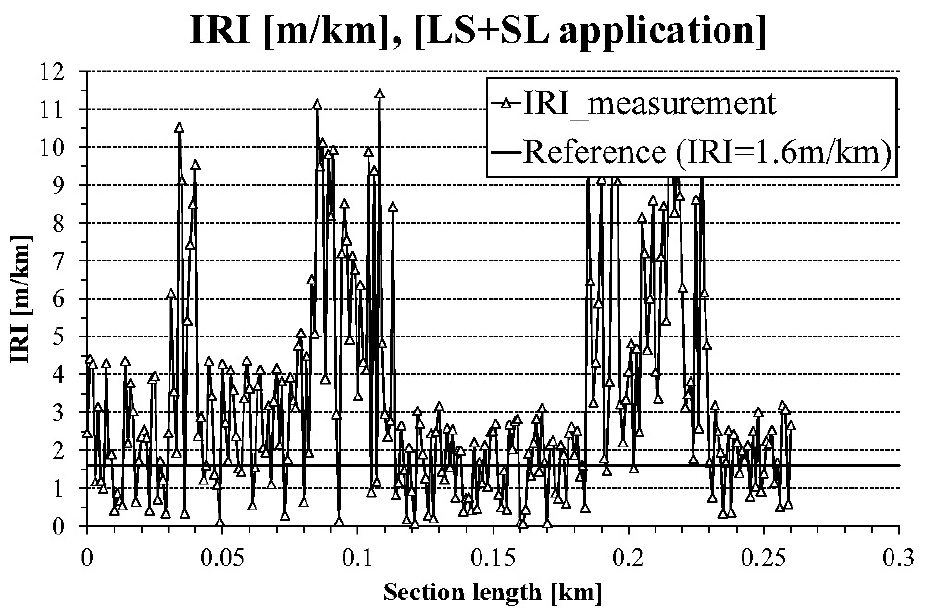
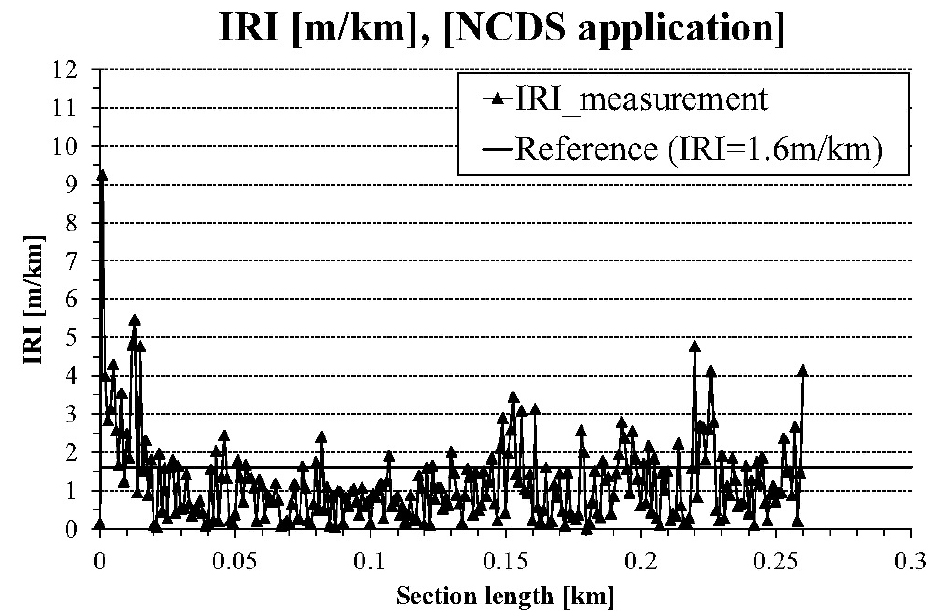
The NCDS equipment is designed for improving pavement smoothness quality, originally. Therefore, IRI : a standard pavement surface quality evaluation criteria, was applied for measuring the smoothness quality performance of NCDS in this paper. The computed results of IRI in this study are shown in Figs. 5 to 6 and Table 2. It is noted that the IRI measurements were performed three times then the averaged values were compared.

Figs. 5 to 6 show the current IRI limit of 1.6 m/km (i.e. horizontal solid line) the pavement construction quality threshold according to the MOLIT guidelines (MOLIT, 2017, 2019). From the results, crucial visual differences were found. Approximately 50% higher values of IRI were found when performing the paving work with the convnetional LS+SL approach compared to the NCDS approach (see Table 2). Moreover, when the NCDS system was used, relatively(or remarkably) lower IRI values (e.g. 1.03 m/km) were investigated suggesting crucial improvements in the asphalt pavement smoothness.
https://cdn.apub.kr/journalsite/sites/jkai/2024-014-02/N0850140222/images/jkai_2024_142_324_F5.jpg
Fig. 5.

IRI results – LS+SL application site (L = 0.25 km)

https://cdn.apub.kr/journalsite/sites/jkai/2024-014-02/N0850140222/images/jkai_2024_142_324_F6.jpg
Fig. 6.

IRI results – NCDS application site (L = 0.25 km)

Table 2.

IRI (m/km) result comparisons : NCDS vs. SL+LS

(A) NCDS (B) SL+LS Difference (A-B)
Average : 1.03
Standard deviation : 0.71
Error : 68.9%
Average : 1.51
Standard deviation : 0.88
Error : 58.3%
Average : 1.03-1.51 = 0.48
Standard deviation :
0.71-0.88 = 0.17

4. Conclusions

In this paper, the feasibility of applying Non-Contact Digital Ski (NCDS) technology was considered and compared with the conventional pavement smoothing solution. After IRI measurements and evaluation, it was found that significantly lower IRI results were obtained in case of the NCDS approach application compared to the conventional one. This findings suggest potentially superior smoothing performances compared to the conventional methods. However, more extended efforts: more field testings, laboratory works and mathematical analyses, are needed to further strengthen the findings in this study.


References

1

Bae, A., Lee, D. and Tan, J.Y. (2015). IRI reduction of HMA overlay on concrete base slab in urban tunnel expressway, Transportation Research Board 94th annual meeting (No. 15-2432).

2

Bae, A., Lee, D. and Tan, J.Y. (2017). "Smoothness improvement by HMA overlay on very rough surface in urban tunnel expressway", Korea Society of Civil Engineering journal of civil engineering, 21(6), pp. 2177-2185.

10.1007/s12205-016-1567-1
3

Bae, A., Sung, L.H. and Jin, J.D. (2018). "Paver sensor system performances on the initial smoothness of HMA pavement", Korea Society of Road Engineers, 20(5), pp. 13-21.

10.7855/IJHE.2018.20.5.013
4

Choubane, B., McNamara, R.L. and Page, G.C. (2002). "Evaluation of high-speed profilers for measurement of asphalt pavement smoothness in Florida", Transportation research record, 1813(1), pp. 62-67.

10.3141/1813-08
5

Dalla, R.F., Liu, L. and Gharaibeh, N.G. (2017). "IRI prediction model for use in network-level pavement management systems", American Society of Civil Engineering Journal of Transportation Engineering, Part B: Pavements, 143(1), p. 04017001.

10.1061/JPEODX.0000003
6

Elagamy, N.M.H. (2016). An experimental and numerical study of three-dimensional fatigue damage in carbon fiber reinforced polymers, Doctoral dissertation, Carleton University.

7

Gillespie, T.D., Sayers, M.W. and Segel, L. (1980). Calibration of response type road roughness measuring systems, National Cooperative Highway Research Program report (No. 228).

8

Gong, H., Sun, Y., Shu, X. and Huang, B. (2018). "Use of random forests regression for predicting IRI of asphalt pavements", Construction and Building Materials, 189, pp. 890-897.

10.1016/j.conbuildmat.2018.09.017
9

Li, N., Qin, R. and Liu, Z. (2013). "Performance Measures and Evaluation of Asphalt Pavements Using the Internal Roughness Index", 1st International symposium on pavement and geotechnical engineering for transportation infrastructure: In Pavement and Geotechnical Engineering for Transportation, pp. 19-30.

10.1061/9780784412817.002
10

McGhee, K.K. and Gillespie, J.S. (2007). "Value of pavement smoothness", Transportation Research Record Journal of the Transportation Research Board, 2040(1), pp. 48-54.

10.3141/2040-06
11

MOBA group (2022). Sonsor product information, https://moba-parts.com/sensors/

12

MOLIT (2017). Guideline for production and construction of asphalt mixture (specification), Ministry of Land Infrastructure and Transportation. (in Korean)

13

MOLIT (2019). Road practice manual. Ministry of Land Infrastructure and Transportation. (in Korean)

14

Robbins, M.M. and Tran, N.H. (2016). "A synthesis report: Value of pavement smoothness and ride quality to roadway users and the impact of pavement roughness on vehicle operating costs", National Center For Asphalt Technology report 16-03, Auburn University, Auburn, Alabama.

15

Sayers, M.W. (1986). International road roughness experiment: establishing methods for correlation and a calibration standard for measurements. World Bank Technical Paper (No. 45. Washington, D.C.).

16

Sayers, M.W., Gillespie, T.D. and Paterson, W.D. (1986). Guidelines for the conduct and calibration of road roughness measurements, World Bank Technical Paper No. 46 (Washington DC).

17

Smith, K.L., Titus-Glover, L. and Evans, L.D. (2002). Pavement smoothness index relationships. Final report (No. FHWA-RD-02-057). United States (U.S.). Federal Highway Administration (Office of pavement technology).

18

Titi, H.H. and Rasoulian, M. (2008). "Evaluation of smoothness of Louisiana pavements based on international roughness index and ride number", Jordan Journal of Civil Engineering, 2(3), pp. 238-249.

19

Writgen group (2022). Big Multiplex Ski (product information), https://www.wirtgen-group.com/en-us/

20

Zaabar, I. and Chatti, K. (2014). "Estimating vehicle operating costs caused by pavement surface conditions", Transportation Research Record Journal of The Transportation Research Board, 2455(1), pp. 63-76.

10.3141/2455-08
페이지 상단으로 이동하기